Showing posts with label fun and games. Show all posts

January 07, 2008

Dangerous things

The last TedTalk to make a big impression on the home education blogs and groups was Ken Robinson's, on how schools educate children to become good workers rather than creative thinkers.

The next TedTalk to start making the rounds and already making a splash is Five Dangerous Things You Should Let Your Kids Do by Gever Tulley of The Tinkering School, a summer program to help kids ages seven to 17 learn to build things. The talk comes from Tulley's book in progress, Fifty Dangerous Things You Should Let Your Children Do; click the book link and you'll find some of Tulley's labels which should be familiar to Make fans; we here at Farm School are always keen on subversive labels and stickers. As I once quoted Charles Darwin,
"Doing what little one can to increase the general stock of knowledge is as respectable an object of life as one can, in any likelihood, pursue."
Gever Tulley and Matt Hern, author of Watch Yourself: Why Safer Isn't Always Better (and whom I wrote about here) certainly seem to be on the same wavelength.

Oh -- those five (really six) things? Not including playing with power tools at age two, which Tulley mentions at the beginning of his talk (and one of these days I'll have to write about my daycare program for Laura when I was pregnant with Daniel; it consisted of sending Laura to work with Tom, her father the builder, six days a week to build a house for a client. Power tools, scaffolding, ladders, and openings to the basement without stairs, were a given. Needless to say, they're all whizzes with power tools by now.)

1. Play with fire

2. Own a pocket knife (better yet, two or three or four, one for each pair of pants)

3. Throw a spear (or a paper airplane, or a baseball)

4. Deconstruct appliances (Tulley suggests a dishwasher, but radios and toasters are great good fun, and if you don't have a dead one of your own, you can find them cheap and ailing at your local Goodwill or Salvation Army store)

5. Break the Digital Millenium Copyright Act (which we apparently do routinely)

6. Drive a car (or truck or tractor if you have no cars about)

Some helpful related links

Interview with Jean Liedloff, author of The Continuum Concept

Kitbashing in the homeschool with Willa at Every Waking Hour and Mama Squirrel at Dewey's Tree House

GeekDad, where I first read last week about Gever Tulley's TedTalk

Boing Boing

Make Magazine and Maker Faire (where the motto is "Build, Craft, Hack, Play, Make")

Make Blog

Craft Magazine

Craft Blog

And, of course, the usual Farm School ramblings about childhood fun, danger, acceptable risk, responsibility, and independence.

December 01, 2007

Keeping warm when it's 24 below...

Playing with matches


Playing with fire


Dangerous and daring


The kids asked all summer if we could make a fire pit; it's been too dry in previous years. Just when things were looking likely, it didn't rain for the entire month of July and temperatures were close to 30C. The grass turned brown and crunchy and fires were out of the question.

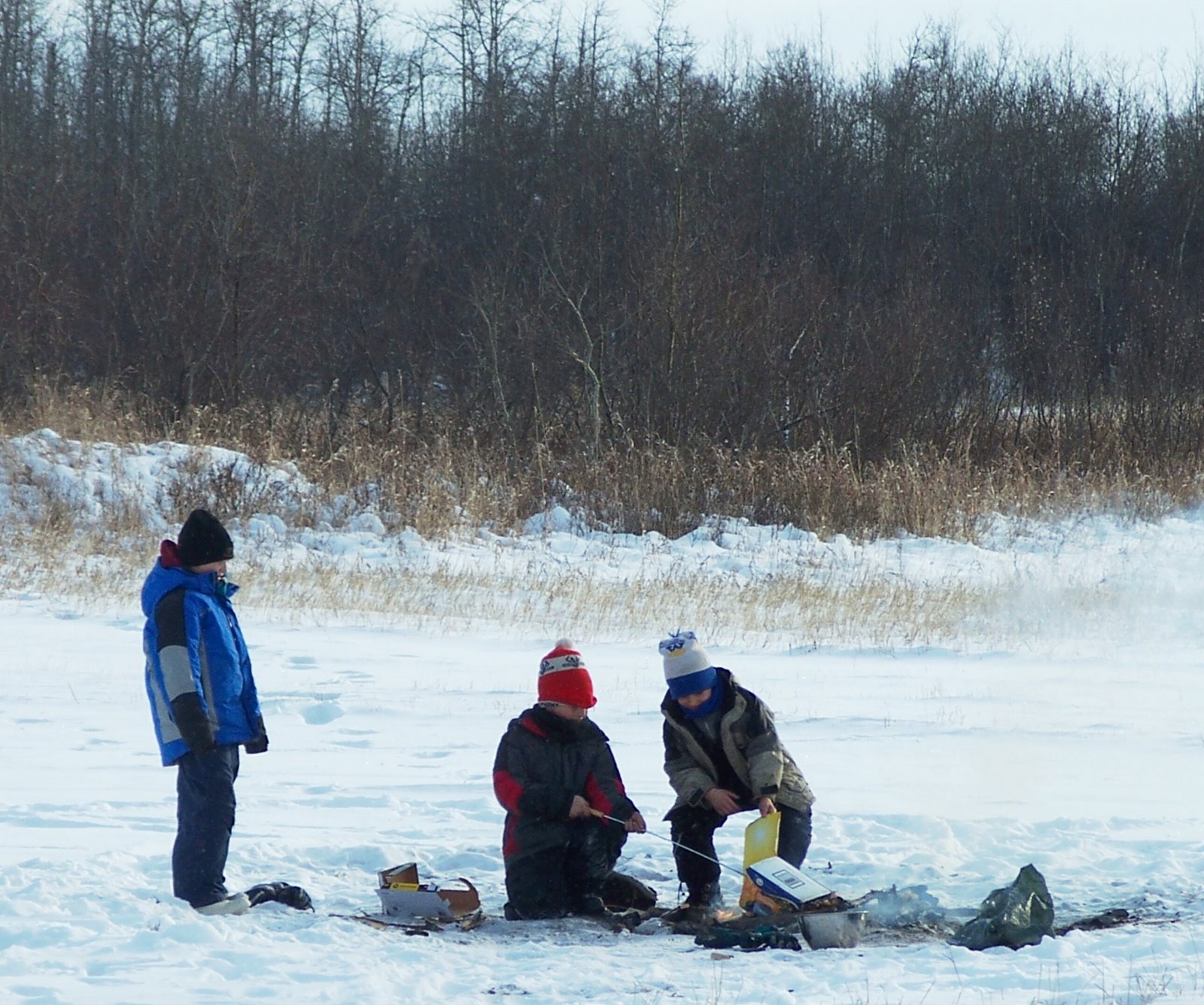
Now, with winter's arrival, a fire pit has become a possibility. The kids spent the other day making a pit out of snow in the front yard. Yesterday they spent most of the afternoon and part of the evening outdoors, roasting hot dogs and marshmallows for lunch and dinner. Today they were back at it, determining just how many hot dogs and marshmallows are too many. Tom and I watched out the window tonight, and we could see three little shapes dancing around the flames.

For tomorrow, they're planning to rig up a grill so they can use a cast iron frying pan to cook bacon, sausages, and eggs. Daniel even asked about sleeping outside, but I told him that freezing to death would spoil our Christmas.

And would you believe that their mother still doesn't like to light matches (hurray for barbecue lighters), especially after that one unfortunate incident in Girl Scouts where she dropped a lit match and nearly burned down the Fifth Avenue Presbyterian Church. Fortunately, the kids didn't for any adult assistance, just trotted off with the matches, and food in a metal bowl from the kitchen.


Next week: running with scissors.

November 27, 2007

Snow fun

The kids rolled the torso and head up the plank.
Note the saw on the snowman-to-be's hip...


Inserting one of the arms


Adding the nose


Now the celery mouth


Last minute snowman surgery (sawing off some
extra snow on the back of the head)


A new friend...

October 21, 2007

The perils of the rural auction sale

Yesterday morning around 10, Tom and the kids left me at home washing windows to attend a farm sale an hour or so away. Tom had his eye on a smaller tractor, one we could use for rototilling around the shelterbelt trees, that was listed in the auction flyer last week.

Well, when they finally rolled in nine hours later, after an afternoon spent eating cups full of homemade beef-and-barley and chicken noodle soup and countless pieces of pie (one of the benefits of the rural auction sale is the food at the concession stand), the kids reported that Dad didn't get the tractor. They seemed unusually giddy.

"But we got HORSES!"

It turns out Tom was the winning bidder on a 14-year-old gray Paint mare and her gray colt, and the mare is supposedly in foal (stay tuned next Spring), a bargain for $550, even without the baby-to-be. If the kids were giddy last night, it didn't compare to this morning while they were getting ready to hitch up the trailer to go with Tom to bring home the new horses.

Pictures to follow.

October 12, 2007

What October on the prairies looks like


if you're eight-and-a-half or almost seven and your mother won't sign you up for hockey in town (because it's thoroughly family unfriendly, with two practices and one game -- far away and with lots of driving -- each and every week) and it's not yet cold enough (thank goodness) for the pond behind the house to freeze.

Besides, for about $20 (about 1/40th of the cost of the official version in town), I've managed to equip them quite nicely thanks to the Goodwill shop, roller skates and hockey skates included. Though the unauthorized baseball glove was bought new. And the goalie stick was rescued from a dumpster.

September 27, 2007

Lawn darts, slingshots, and pellet guns, oh my...

Not to mention lead-filled toy soldiers.

"Hasbro gets Dangerous", Toy News Online reports. But no fear of boys putting their eyes out or requiring stitches, because Hasbro's idea is to "develop board and travel games based on the hugely successful book brand":
Andrew Lane, licensing director at Hasbro, said: “The book is fantastic, a fabulous concept and rich in material with which we can develop some great games”.

“We have established a key partnership with Hasbro, the first of many internationally renowned licensees we shall be signing. Our aim is simple, to make The Dangerous Book for Boys the best boys licensed brand ever” said Charlie Donaldson at Rocket Licensing.

August 28, 2007

Why safer isn't always better

Listening to CBC Radio's "Sounds Like Canada" show last week (podcast here; let me know if the link doesn't work), I heard summer host Kevin Sylvester interview Matt Hern about the new U.S. edition of his book, Watch Yourself: Why Safer Isn't Always Better, out last month in paperback; it was published in Canada last summer, but both Amazon.ca and Chapters list it with 4-6 week and 3-5 week availability, never a good sign, I've found.

The radio conversation, which was continued on today's "Sounds Like Canada" show, and subject of the book, are right in line with my own thoughts about childhood fun, danger, acceptable risk, responsibility, and independence. From the publisher's website:
From warnings on coffee cups to colour–coded terrorist gauges to ubiquitous security cameras, our culture is obsessed with safety.

Some of this is drive by lawyers and insurance, and some by over–zealous public officials, but much is indicative of a cultural conversation that has lost its bearings. The result is not just a neurotically restrictive society, but one which actively undermines individual and community self–reliance. More importantly, we are creating a world of officious administration, management by statistics, absurd regulations, rampaging lawsuits, and hygenically cleansed public spaces. We are trying to render the human and natural worlds predictable and calculated. In doing so, we are trampling common discourse about politics and ethics.

Hern asserts that safer just isn’t always better. Throughout Watch Yourself, he emphasizes the need to rethink our approach to risk, reconsider our fixation with safety, and reassert individual decision–making.
Much more conversation on the radio than the website about the effect of all this caution on our children.

Looking up the book and author online, I was interested to learn that six years ago Matt Hern founded the Purple Thistle Centre for Youth Arts & Activism, a "deschool" in Vancouver, BC with "alternative ways of taking in information or learning skills". Hern has written more about his thoughts of learning and deschooling in two books, the out-of-print Deschooling Our Lives (shades of Ivan Illich) and Field Day: Getting Society Out of School.

On a more lighthearted note on the subject of danger, I ran across this post, The Borderline Sociopathic Book for Boys, at the new-to-me and very enjoyable blog Sippican Cottage. The post has inspired Sippican's new blog, The Borderline Sociopathic Blog for Boys, guided by the words of Mark Twain, "Now and then we had a hope that if we lived and were good, God would permit us to be pirates." And, just in time for back-to-school season, don't miss Sippican's post last week on schools and education.

July 29, 2007

New for dangerous girls and daring boys

New since the beginning of the month ig The Dangerous and Daring Blog for Boys and Girls -- "inspired by The Dangerous Book for Boys and the upcoming The Daring Book for Girls" but "not connected in any way to the authors or publishers of those books". Rather, the new blog is brought to you by The Llama Butchers, who I believe came to my attention through our mutual pal Melissa Wiley.

Labels/categories so far with corresponding posts include

Battles (1)
Build It (1)
Dangerous (10)
Daring (8)
History (4)
Hobby (1)
Outdoors (2)
Rocketry (2)
Science (1)
Stories (1)

Wowie! I believe I know a few children out on the open prairie who might have fun with those two rocketry posts.

Grand fun to bookmark and to add to the Bloglines subscription. Great good thanks to the LBs for the new blog, especially while there's still plenty of summer left for unfettered, dangerous, and daring summer fun.

(I hope to post a fair report toward the end of the week, and do some general bloggy catching up. But tomorrow morning we're off to the fairgrounds again for the day for the big volunteer clean-up.)

June 07, 2007

You pick

the lesser of two weevils:

Doll Web Sites Drive Girls to Stay Home and Play, as reported by The New York Times yesterday (free registration or use Bug Me Not)

or

The Daring Book for Girls, the not very daring but very manufactured response to The Dangerous Book for Boys, pandering to those who say they are offended by a "boys only" tome and hoping, no doubt, to strike the same nerves and chords as has The Dangerous Book. Coming in time for Christmas 2007.

As I sit here tapping away, wearing my father's old blue dress shirt over my husband's t-shirt (it's a bit cool here this morning), while Laura slurps her cereal and reads her brother's copy of The Dangerous Book for Boys breezily ignoring the last two words in the title and thoroughly unaware of the Cartoon Doll Emporium, Club Penguin, Cyworld, Habbo Hotel, Webkinz, WeeWorld and Stardoll, I wish you a summer of uncomputerized, unmanufactured, unfettered fun.

May 16, 2007

In search of freedom and independence, and big bangs

For Daniel's eighth birthday last month, his grandfather sent him the UK edition of The Dangerous Book for Boys by brothers Conn Iggulden and Hal Iggulden. The book, an oversize red-covered tome, is an appealing jumble of activities and projects (make your own battery or tree house or the greatest paper plane in the world, learn basic first aid, five knots every boy should know), as well as useful knowledge -- there are chapters on grammar, some of Shakespeare's most famous quotations, Latin phrases every boy should know, and stargazing. Rather like E.D. Hirsch's "What Your 4th Grader Should Know", but in one volume with matches, alum, and copper batteries.

Snitching it from my son to read, at first I wished that the like chapters were lumped together, all the Famous Battles chapters and Extraordinary Stories (about extraordinary lives) together, and the various astronomy chapters (Astronomy, Charting the Universe, The Moon, The Solar System) together too, but then I realized I was looking at the book as a home educating adult woman in her forties, when what the average seven to 12 year-old boy (or girl -- and anyone who lets the title of a book stop her has other problems) probably wants is the surprise of discovering what's next. And that means chapters on codes and ciphers (including charts for Morse code and the NATO phonetic alphabet), making crystals, the story of Scott of the Antarctic, making a go-cart, and insects and spiders, side by side, by side by side. Enough to keep one happy on "Sunday afternoons and long summer days", as noted on the book's back cover, as well as winter days and tucked under the covers with one's torch, er, flashlight, reading about Joe Simpson's harrowing 1985 mountain-climbing expedition in the Andes with his friend Simon Yates.

The Dangerous Book reminds me a bit of an old but very useful doorstop I have on the shelf, the 1931 edition of The Volume Library: A Concise Graded Repository of Practical and Cultural Knowledge Designed for Both Instruction and Reference, with sections on Education, Language & Grammar, Literature, History, Geography, Trade & Industry, The Atlas, Biographical Dictionary, Dictionary, Mathematics, Science, Hygiene, Government & Law, Fine Arts, and Useful Miscellany (which, like The Dangerous Book, includes Answers to Puzzling to Questions). More than half the fun lies in not knowing where a turn of the page will take you, and knowing that you are also certain to learn something new and fun. But dangerous only in the sense that a little learning, even about knot-making, is a dangerous thing.

Likewise, there's little dangerous or even brand-spanking new in the Igguldens' book for old-fashioned, or I suppose "retro" (sounds less conservative and more trendy, doesn't it?), families, where childhood still includes a bicycle, a patch of green to run around in, with some Latin and Shakespeare thrown in for good measure. And those of us who are fortunate enough to have the fortitude or constitution to let the running around be fairly unfettered (that would be those of us whose kids have all needed stitches and whose idea -- the kids', that is -- of fun is leaping off stacks of big round straw bales), Dangerous is more of a remedial summer camp (and summer school) in a book, and there's nothing wrong with that, especially for those last children in the woods. Which is probably why the book has been so popular in the UK and now the US.

Daniel, always one of the first children in the woods, in the mud, and into his father's tools, reports that his new book "is good and it's fun, but it's more of a reading book than a doing book". His first choice for a "doing" book is still The American Boy's Handy Book by Daniel Carter Beard (do yourself a favor and get the Centennial edition published by Godine, with the lovely foreward by the late Noel Perrin), which is on target with my thoughts last year.

So I was interested to learn that both Daniel and I are in complete agreement with Mark Frauenfelder at Boing Boing, who wrote last week in his post Dangerous books for boys (and girls and men and women): "While the book is beautifully produced and entertaining, it really doesn't contain any risky projects that the title and nostalgic design suggest."

To remedy that, Mark suggests a list of his favorite "dangerous" books, including a couple by his friend (and Farm School favorite) William Gurstelle; also on the list is the Manual Of Formulas: Recipes, Methods and Secret Processes, originally published by Popular Science Magazine in 1932, which I think is the volume still on my parents' kitchen shelf; I read it often but didn't use it much because it required so many exotic, um, ingredients. (Though Davy might find the information on how to re-ink typewriters useful.) In a similar vein is Lee's Priceless Recipes: 3000 Secrets for the Home, Farm, Laboratory, Workship and Every Department of Human Endeavor compiled by Dr. N.T. Oliver, which I discovered in the Classic Reprint series section of the Lee Valley Tool catalogue. The 1998 facsimile edition is a handy dandy size, 4-1/2" by 6" (and just under an inch thick), just right for keeping in a pocket or storing in, oh, say, a tree house, and was a bargain at under $8 Canadian; not surprisingly, the new edition comes with the following warning:
This is a reprint of a book compiled in 1895. It describes what was done and what was recommended to be done in accordance with the knowledge of the day.

On the medical side, some of the proposed remedies would not only be considered inadequate today, but would also be considered potentially harmful.

ON ALL MEDICAL ADVICE, CONSULT YOUR PHYSICIAN. DO NOT TAKE THE ADVICE GIVEN HERE.

It would also be advisable to treat all corrosive, explosive, and toxic materials with greater caution than is indicated here, particularly any materials that come in contact with the body.
Not a bad idea when some of the recipes, only a few for food (ice cream, lemonade, beer, etc.), include how to make "camphorated tincture of opium" for whatever ails you, and the book has an entire section on "Fireworks and Explosives", with instructions on how to make dynamite. Dangerous doesn't begin to cover it.

What caught my eye in Mark's list of books was his mention of The Golden Book of Chemistry Experiments, first published in 1960 by the Western Publishing Companty, in part because the kids spent the better part of the winter enjoying Golden Book's Complete Book of Indian Crafts and Lore by W. Ben Hunt, and in part because the book is said to have influenced the Radioactive Boy Scout. Mark writes [emphasis on the third paragraph mine],
Dangerous projects [in The Golden Book of Chemistry Experiments] include: making chlorine, ammonia, hydrogen, and ethanol.

The book is long out of print, and used copies are very expensive (Amazon.com has used copies for over $100). Of course, in today's litigious environment, no major publisher would dare republish a book that had actual chemistry experiments in it, for fear getting sued. I have long wanted to own a copy of The Golden Book of Chemistry Experiments. I sort of forgot about it, but recently a friend emailed me a page he had scanned from a copy he owns. It prompted me to search for a sub-$100 copy. I got lucky and found a $0 copy, thanks to BitTorrent. Here's a link to the torrent file for a nice scan of the 112 page book.

The book is an example of everything great about vintage children's science books. Once you lay your eyes on it, you will come to the sad realization that our society has slipped backwards in at least three important ways: 1. The writing quality in old kids' science books was better; 2. The design and illustration was more thoughtful and skillful; 3. Children in the old days were allowed and encouraged to experiment with mildly risky but extremely rewarding activities. Today's children, on the other hand, are mollycoddled to the point of turning them into unhappy ignoramuses.
Which ties in nicely with a point Natalie Angier made last week in her CBC interview about her new book, The Canon: A Whirligig Tour of the Beautiful Basics of Science, which I forgot to mention in my post the other day, that the worrying drop in children's scientific literacy is due in part to the idea kids have of science as dry and boring, brought home to them daily by dry and boring textbooks.

Unfortunately, BitTorrent doesn't work for those of us with Macs. I did find a free online PDF file of The Golden Book of Chemistry Experiments,though it's nearly useless for country bumpkins on slow dial-up; interestingly, I discovered the PDF link in this nifty post about retro science books, which also mentions Mr. Wizard's 400 Experiments in Science, by Don Herbert and Hy Ruchlis (the post also laments the absence of Mr. Wizard on DVD, though the kids and I discovered recently via Zip.ca that Mr. Wizard is indeed available on DVD). In some brief email correspondence, Mark at Boing Boing was kind enough to mention that The Golden Book of Chemistry Experiments can be had in book form from Lulu for under $30 US, which does appeal to the Luddite in me, not to mention handier for handing to your child. And spark an idea for more chemistry for school next year, especially if I remember to order the current catalogue from the homeschool-friendly Boreal Northwest lab supplies (which operates in the US as ScienceKit.com). Now if only I could get Tom to build us a small lab building, separate from the house, where the kids could make messes and things could go bump (and boom) in the night.

I'll leave you with a bit of Noel Perrin's foreward to the 1983 centennial edition of American Boy's Handy Book, on the book's author, Dan Beard:
...of all the attempts to preserve wildness that he made in a long life (and he lived to be 90), the most successful was the book you are holding. It began as a series of articles for the old St. Nicholas magazine, designed to encourage city boys to recover their natural independence and self-sufficiency. It first became a book in 1882. For the next half-century it went through edition after edition, as innumerable fathers gave it to innumerable sons. Then as the new concept of boyhood gained strength, interest in the book faded, and now it has been hard to find for fifty years.

The book will be interesting to contemporary boys (and some girls, too, which would startle Mr. Beard) in two ways. First, like Huckleberry Finn -- or William Dean Howells' A Boy's Town, or Thomas Bailey Aldrich's The Story of a Bad Boy, or even like some TV programs on the "Little House on the Prairie" model -- it gives a picture of a kind of childhood now quite rare. Being a manual or handy-book, it gives an unusually faithful picture. Beard describes nothing that American boys weren't really doing a century ago -- in fact, nothing that it didn't seem to him almost any boy could (and would want to) do. It's like being given a glimpse of your great-grandfather's boyhood, only with none of the romantic haze the old man would cast around it, if he were alive and telling the story. Or it's like a look behind the scenes in Mark Twain. So that's how Huck and Jim cooked catfish; that's how he and Tom Sawyer must have made fire-balloons.

But the book is even more interesting as an actual manual to use right now. It is possible -- in fact, normal -- to watch "Little House" in an entirely passive mode, with no thought of clicking off the set and going out to dig a well or catch prairie dogs. It is not possible to read The American Boy's Handy Book without feeling a desire to try some of the things Beard talks about.

Parts of the book are, of course, outmoded. No one can go to the village glazier now and pick up free bits of surplus glass to use in making a home aquarium, or trot down the street to the blacksmith with directions for a couple of metal parts you want him to forge. ...

But because nature itself has changed hardly at all over the past century, however much our attitude toward it has, and because jackknives, axes, and fishhooks remain readily available, a good half of the directions are as useful today as they were in 1882. And as fascinating.
Not to mention dangerous.

If you'll excuse me now, I have to teach my six-year-old how to burn a hole in a leaf with a magnifying glass.

UPDATED to add: I forgot to mention one of our favorite out-of-print chemistry books, The How and Why Wonder Book of Chemistry by Martin L. Keen, illustrated by Walter Ferguson, published by Grosset & Dunlap, 1961, part of The How and Why Wonder Book series. The books are generally paperback, large format, more than 48 pages, profusely illustrated (with maps, charts, and drawings, rather than photographs), and begin with a narrative approach followed by a question-and-answer format. The Chemistry volume covers subjects from "What Is Chemistry?" and "The Ancestors of Chemistry" to "The Language of Chemistry", "Some Interesting Elements", "Organic Chemistry", and "The Branches of Chemistry". Well worth the (Canadian) quarter I spent, considering the original price was 59 cents. We've got quite a few How and Why Wonder Books, and I've been keeping my eyes open for "The How and Why Wonder Book of Beginning Science" and "The How and Why Wonder Book of Science Experiments", among others.

April 25, 2007

Fun with gunpowder

Last summer I wrote about my brief thoughts on The Dangerous Book for Boys (American website here); I said at the time I thought that for our purposes Daniel Carter Beard's classic, The American Boy's Handy Book, was a better book for our purposes.

Now, with the news that my father is sending a copy of The Dangerous Book to Daniel for his eighth birthday, coming up this weekend, and after reading a piece on the Iggulden brothers, Conn and Hal, in the current issue of Vanity Fair magazine (which I like for the articles and the pictures), I'm prepared to admit there is room on the shelf -- the one devoted to old-fashioned children's pastimes -- for The Dangerous Book as well. The main difference between the two books is that while The American Boy's Handy Book includes only projects, The Dangerous Book includes guides to proper English usage, as well as a series of "Extraordinary Stories", such as "the one on the exploits of World War II R.A.F. fighter ace Douglas Bader*, who racked up the fifth-highest number of kills in the Royal Air Force despite his flying with prosthetic legs":
As Conn explains, it's really not about the penknives and air rifles, "it's to do with the way children are raised and what they consider important." Which is why he considers "Extraordinary Stories" vital to the book. "If you put in a story of incredible endurance or courage, you are saying these are impressive values," he says. "[Boys today] don't get heroic stories in the way I did. And I think they're desperately important."
Somewhere, quite rightly, Charlotte Mason is beaming. And the folks at Flying Point Press who are bringing back the Landmark books should be smiling, too.

I was particularly heartened to read, while the Igguldens were expecting some British backlash because of activities involving "power tools, penknives, and -- in the case of a procedural on rabbit-hunting -- an air rifle and entrail work", the backlash never came, since the book struck a chord with British families. The authors may not be so lucky in the US, where the publication of an American edition next month -- next Tuesday, in fact -- no doubt inspired the VF feature. Publisher's Weekly interviewed one of the brothers, who, in response to the question "What do you think it is about this book that’s resonating with today’s kids, who clearly have a lot more than a book on how to tie knots vying for their attention?", answered,
A lot of parents are getting fed up with an overly restricted attitude for their children, much of that coming from their government. Paper airplanes are being banned in the schools for fear of someone poking their eye out. That sort of thing is slightly annoying and really isn’t good for children, especially boys. They have to learn where their own limits are. We’re taking about managed danger here. We don’t want them running out under cars. But if they don’t [learn what their limits are], God knows what sort of pale, white, fat adults they’ll become.
To which both PW commenters so far unsurprisingly took exception (should one even bother to point out that what Mr. Iggulden was referring to were pale, white grubs? You know, the kind that live outdoors, in nature, under logs. Heavens, get those commenters out from under their logs and away from their computers for a bit of fresh air and sunshine.)

And then there's this recent wire service article from various online North American news websites,
Exuding the brisk breeziness of Boy Scout manuals and Boy's Own annuals, "The Dangerous Book" is a childhood how-to guide that covers everything from paper airplanes to go-carts, skipping stones to skinning a rabbit.

It spent months on British best-seller lists, has sold more than a half-million copies and took the book of the year prize at last month's British Book Awards.

The book will be published in the United States May 1, allowing American boys -- but not their sisters -- to learn how to play marbles, make invisible ink, send Morse code and build a tree fort. ...

It's possible to see a less wholesome side to the book's nostalgia. Girls are discussed, in a single chapter, as something akin to another species: "They think and act rather differently to you, but without them, life would be one long football locker room. Treat them with respect."

Girls are explicitly -- and, some argue, unnecessarily -- excluded by the book's title. ...
Though why North Americans can't figure out that girls, and women, are most welcome to pick up the book and make use of it, is a mystery.*

Danger on American shores, Will Robinson, danger!

*I will admit, however, to more than a bit of discomfort, however, at the Igguldens' UK website's shilling of The Goddess Guide, especially since it seems geared more toward women than girls. I apologize for any retching sound you may hear coming from my direction. I'm willing to bet my collection of pocketknives confiscated while doing the laundry that the mention is there by order of HarperCollins, who should give the decision a bit more thought. Especially since they made sure that the "Girls" page didn't make it to the US website.

UPDATED to add: Just learned that earlier this month The Guardian's The Bookseller section included the following item:
The runaway success of The Dangerous Book for Boys has inspired Penguin to start a list of "boy's own" classics. Six end-of-empire adventure tales are being given nostalgic covers, aimed squarely at the Father's Day market in June. They are: The Lost World by Sir Arthur Conan Doyle; She by H Rider Haggard; The Prisoner of Zenda by Anthony Hope; The Riddle of the Sands by Erskine Childers; The Thirty-Nine Steps by John Buchan; and The Man Who Was Thursday by GK Chesterton. A dashing collection for any middle-aged boy's bookshelf.


* If you happen to discover on TV the 1956 British movie Reach for the Sky, starring Kenneth More as Bader, watch it with your kids. Not on DVD in North America any more, though you can find it in the UK.

July 05, 2006

Outdoor life, or, How to have an old-fashioned, dangerous summer

A city-living friend, who always seems half-alarmed and half-amused by the fact that my kids tend to go through their days fully armed (pockets full of slingshots, jackknives, cap pistols, and lengths of rope, the latter of which came in surprisingly handy the other week when we had to move a neighbor's sheep) and whose idea of fun is to leap off bale stacks and on and off a moving horse, emailed me the recent Guardian article about new UK publishing sensation, The Dangerous Book for Boys by novelist Conn Iggulden and his brother Hal. My friend wanted to know if I'd heard of the book, if I would recommend it for her city boy, and if I'd be buying it for my three desperadoes. "It tells you how to make a tripwire, you know," she wrote.

I wrote back that, based on what I'd read about The Dangerous Book, what she really wants is The American Boy's Handy Book written and beautifully illustrated by Daniel Carter Beard, the American outdoorsman and illustrator whose Sons of Daniel Boone organization was a precursor of the Boy Scouts. Available for half the price of The Dangerous Book and endangering lives for more than 100 years, the Boy's Handy Book includes such projects and activities as How to Rig and Sail Small Boats (so you too can spend all summer dodging drowning just like the siblings in Swallows & Amazons), Home-Made Hunting Apparatus, How to Make Blow-Guns, Practical Taxidermy for Boys, and, proving that danger lurks year-round, Snowball Warfare. In fact, with the extra money, you can also buy The American Girl's Handy Book by Daniel's sisters, Lina and Adelia, rather more genteel but equally nostalgic and useful; or Daniel Beard's Field and Forest Handybook: New Ideas for Out of Doors. While poking around for links to share, I found this, for Daniel Carter Beard's Online Books. Well worth a peek.

More old-fashioned outdoor summer fun, dangerous and not so, and don't be put off by any of the "Boys" in the titles if you have girls:

The Boy Mechanic, a four-volume series by the editors of Popular Mechanics, reprinted by the good folks at the Canadian woodworking and gardening institution Lee Valley, which also offers the reprint Boy Craft

Historical Headgear, Hats and Helmets: Where History Meets Duct Tape: The Ancients by Jean Lockwood and Thomas Lockwood; think of it as Red Green meets the Story of the World activity book. The publisher, BrimWood Press, new to me, specializes in "Tools for Young Historians" -- definitely worth a look. (The "Coloring the Western World" coloring book has me very, very curious despite the $18 price tag. Color me interested.) Your kids can wear their helmets while perusing and working from

the classic Backyard Ballistics by William Gurstelle, author too of The Art of the Catapult: Build Greek Ballistae, Roman Onagers, English Trebuchets, and More Ancient Artillery

Mud Pies and Other Recipes: A Cookbook for Dolls by Marjorie Winslow, illustrated by Erik Blegvad; more genteel but not necessarily tidy fun

UPDATED July 10th to add that yesterday I realized that Jen at her Book Page also had a post on the The Dangerous Book, which somehow I missed when it originally went up; I like Jen's idea that "you could have a lot of fun with finding companion books where kids in the book engaged in some of the same activities!" By the way, now that Jen's back from her holiday, she's posted another one of her nifty Sunday round-ups.