More apologies. I've been meaning to post links to all of Harold McGee's "Curious Cook" columns in The New York Times but fell down on the job. I was reminded by yesterday's column, so below is the list. Once again, you need to register to read NY Times articles, but registration is free.
Harold McGee is the author of the classic On Food and Cooking: The Science and Lore of the Kitchen, and also of its (apparently out-of-print) follow-up, The Curious Cook: More Kitchen Science and Lore, from which the Times column takes its name.
* * *
The Invisible Ingredient in Every Kitchen, January 2, 2008; go to The Curious Cook website, where you'll find a link to this NPR column by Bill Buford on Mr. McGee and heat.
A Blue Blood New in Name Only, December 5, 2007
Stalking the Placid Apple’s Untamed Kin, November 21, 2007
Organic, and Tastier: The Rat’s Nose Knows, October 3, 2007
The Essence of Nearly Anything, Drop by Limpid Drop, September 5, 2007
Ice Cream That's a Stretch, August 1, 2007
Testing Whether the Crunch Is All It’s Cracked Up to Be, July 4, 2007
Extra Virgin Anti-Inflammatories, June 6, 2007
The Five-Second Rule Explored, or How Dirty Is That Bologna?, May 9, 2007
The Red-Meat Miracle, and Other Tales From the Butcher Case, April 4, 2007
What’s a Great Way to Get a Fish Fried? Give It a Shot of Vodka, March 7, 2007
In a Bottle, the Scent of a Mouse, February 7, 2007
Trying to Clear Absinthe’s Reputation, January 3, 2007
When Science Sniffs Around the Kitchen, which kicked off the series, December 6, 2006
* * *
And, not part of The Curious Cook series, but also interesting, The Times ran this article, "Food 2.0: Chefs as Chemists" the other month.
Showing posts with label chemistry. Show all posts
Showing posts with label chemistry. Show all posts
January 03, 2008


Retro chemistry
I'm so far behind in my Boing Boing reading that it's not even funny -- GeekDad I can manage (and there's a nifty post today about sorting/storing Lego) -- but my spidey sense started tingling when I read Melissa's frog post at Here in the Bonny Glen.
Melissa links to an article from the 1934 issue of Modern Mechanix and Inventions, reprinted over at the Modern Mechanix blog, which is new to me -- a veritable treasure trove. And looking down the blog's list of categories I came to "Chemistry" and got ridiculously excited. Heaps and heaps of articles, mostly from Popular Science and mostly by Raymond B. Wailes, author of my old childhood favorite Manual Of Formulas: Recipes, Methods and Secret Processes. By the way, here's a spiffy article by Norm Stanley on the subject of amateur science that mentions Mr. Wailes, from the Society of Amateur Scientists website.
There are also categories for History, Science, Toys and Games, and enough other subjects to keep the retro heart beating quickly all year.
Melissa links to an article from the 1934 issue of Modern Mechanix and Inventions, reprinted over at the Modern Mechanix blog, which is new to me -- a veritable treasure trove. And looking down the blog's list of categories I came to "Chemistry" and got ridiculously excited. Heaps and heaps of articles, mostly from Popular Science and mostly by Raymond B. Wailes, author of my old childhood favorite Manual Of Formulas: Recipes, Methods and Secret Processes. By the way, here's a spiffy article by Norm Stanley on the subject of amateur science that mentions Mr. Wailes, from the Society of Amateur Scientists website.
There are also categories for History, Science, Toys and Games, and enough other subjects to keep the retro heart beating quickly all year.
November 30, 2007
Cybils Review: The Periodic Table: Elements with Style!
 The Periodic Table: Elements with Style!
 created (and illustrated) by (Simon) Basher, written by Adrian Dingle
128 pages; for ages 10 and up
Kingfisher Publications (Houghton Mifflin Co.)
Library copy
I've been looking forward to reading this book ever since I saw it mentioned on Carol's and Rebecca's blogs.
Artist Simon Basher and chemistry teacher Adrian Dingle have created a vivid rogues' gallery of elements guaranteed to bring the periodic table to life and appeal to kids of all ages. I'll be the first to admit I'm the originally fuddy-duddy, but there's something about this anime-style, Facebook approach to the periodic table that's remarkably engaging. Not to mention a sensible approach to making the subject -- indeed, the individual elements -- memorable for everyone from fourth or fifth graders to college seniors (not to mention home educating parents who majored in, say, history).
And memorable is what you want when it comes to learning about the periodic table. Basher, who came up with the idea for the book, has said, "It’s really been designed to engage you on a gentle level and also to act as a memory trigger. There really is no reason to think of science as boring, as I’ve discovered, and I hope readers will see the fun side of it." Echoed by Mr. Dingle, who writes, "This is not an academic book by any stretch of the imagination, but it does offer a window or gateway to getting interested in the elements. I see it as a very accessible opportunity to learn a little about some chemistry." In fact, The Periodic Table takes the "memory trigger" several giant steps further than does another nonfiction book familiar to home schoolers -- Yo, Millard Fillmore -- because the illustrations and text are all about the elements.
The small book -- seven inches square, and 128 pages -- opens with an introduction explaining just what an element is and how (and why) the periodic table is arranged. Then nearly every element gets its own double-page spread, with an illustration and first-person narrative, accompanied by symbol, atomic number and weight, color, standard state, classification, etc. Here's the write-up for Bad Boy lead, depicted as a Roman gladiator:
Don't let my heavyweight status fool you -- at heart I'm a completely malleable softy. I am so easy to work with that the ancient Romans used me for their water pipes. My chemical symbol (and the word "plumbing") comes from by Latin name, plumbum.Adding to the delight is a removable periodic table poster -- definitely stylish, more cool than geeky -- accompanying the book. Just the right thing for your young scientist to hang over the desk (or bed, depending on how much he or she really likes this stuff); though I realize, aside from the home educating crowd, who'll be tempted to post it in the kitchen, most families will be content to borrow the book from the local or school library. Besides the poster, the book also includes an index and a glossary.
Over the years, I've gained a bad rep. People say that I build up in bones as a slow poison and that I have damaged childrens' [sic] development. It's true that I have an unfortunate ability to slip easily into the food chain -- from pipes and cookware, leaded gasoline, and paints to fisherman's weights. I have also been blamed for ending the ancient Roman civilization. Not fair! These days, I am closely regulated. But I am still used as a shield against x-rays, for roofing, and in stained glass.
For more on the writer and illustrator, see interviews with each at Houghton Mifflin's website. Asked, "Were you good at chemistry as a student? Would a book like this have helped you?" and "Did you have any inspirational teachers who got you excited about science or art?", Basher replies,
I liked the idea of chemistry but found the textbook really unstimulating. I always had more of an interest in art and music.And my favorite bit, from Mr. Dingle the chemistry teacher,
I was lucky enough to have a great high school art teacher who really encouraged me to look at new art and also introduced me to a lot of great music. My passion for science and math came much later in life. While working on the book I did meet a materials scientist from MIT who really gave me some fantastic ideas and tips for the book. He had a real passion for art as well and he loved the idea.
Science is a serious business, and I think the way to get people engaged is to make it accessible while still presenting hard facts and knowledge. Also, I don’t believe that science is “for all.” Some people will have an academic bent for it, others will not — that’s fine, but the answer is not to dumb down science so that everyone can “get it.”Now there's something everyone can get.
* * *
More Periodic Table Fun
Further reading, for the younger set:
The Mystery of the Periodic Table by Benjamin D. Wiker, with charming illustrations by Jeanne Bendick; a delightful living book, published in 2003 by Bethlehem Books as part of their "Living History Library".
Dawn's favorite chemistry book, It's Elementary: Put the Crackle in Chemistry (look inside the book here)
Further reading, for older children and adults:
Nature's Building Blocks: An A-Z Guide to the Elements by John Emsley (and if you liked that, just for fun don't miss his entertaining -- and "sordid" -- history of phosphorus)
More periodic tables:
The animated version of Tom Lehrer's ditty on The Elements (don't forget to turn your sound up); many thanks to the generous and creative Mike Stanfill
Theodore Gray's Wooden Periodic Table Table (no, that second "Table" isn't a typo), and his very stylish periodic table posters. And don't miss his fun columns at Popular Science.
The Royal Society of Chemistry's Visual Elements Periodic Table, available in Flash or HTML versions, and which you can buy as a wall chart or CD-ROM
The Comic Book Periodic Table of the Elements
Rader's Chem4Kids Periodic Table and clickable Element List
Prof. Mokeur's interactive and printable periodic tables, and his game of Elementary Hangman
An interactive periodic table. And another one.
Chemicool's periodic table
UPDATED to add: From the comments below, Crissy at Soliloquy's favorite periodic table is here. (If you have trouble with that link for some reason, try this one.) She downloaded the PDF and printed a 20" x 30" poster for each of her sons. Many thanks for sharing that one, Crissy!
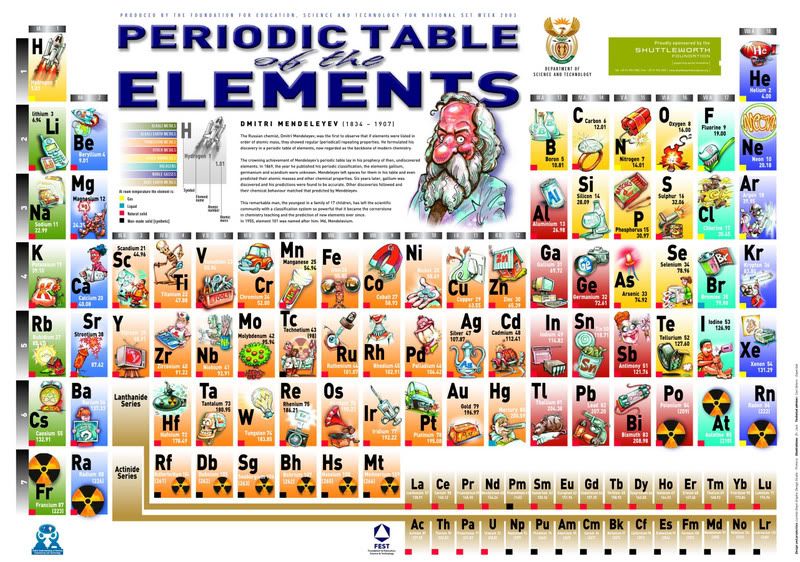
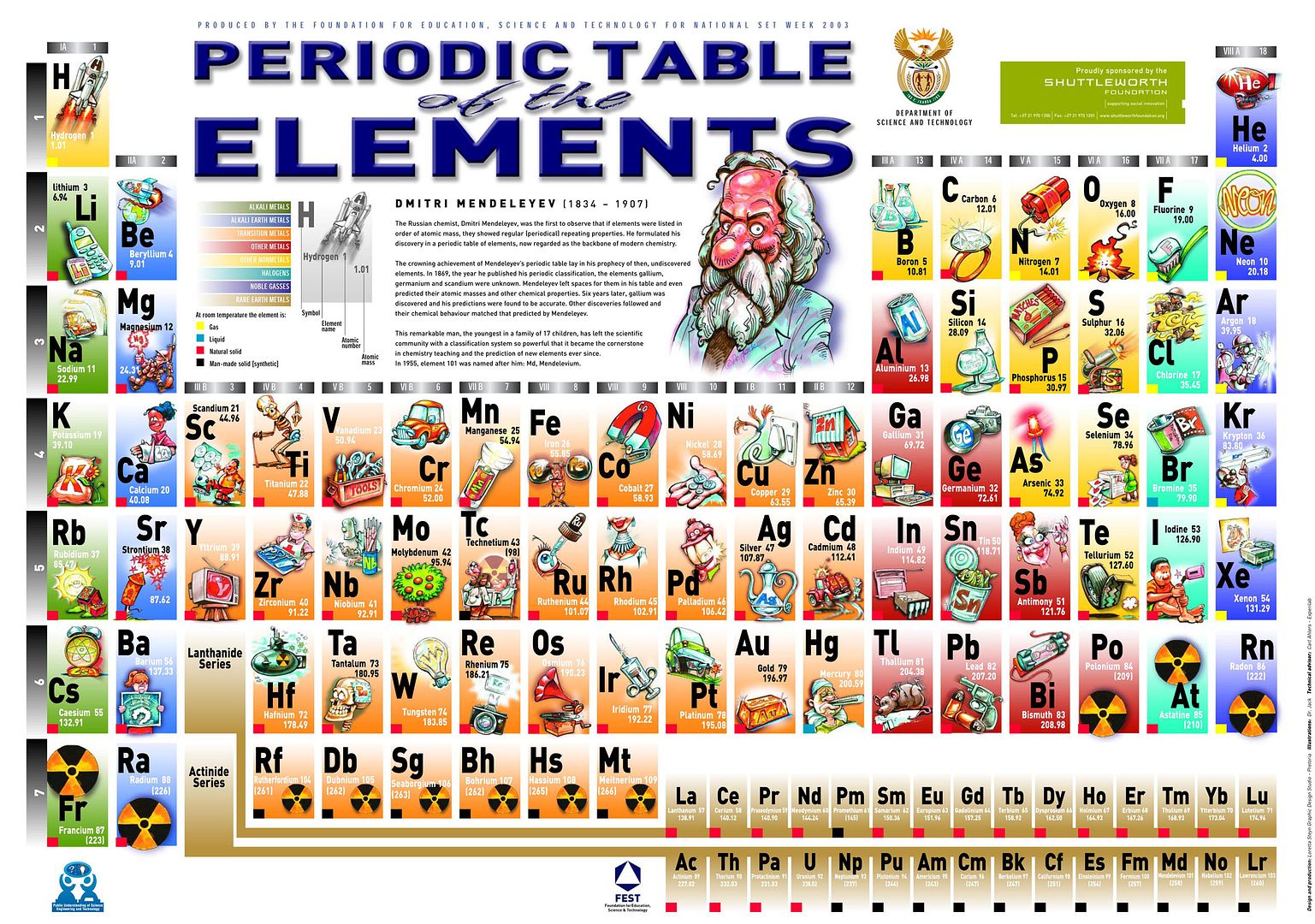
From Adrian Dingle:
His website, especially handy for AP chem students; don't miss the links page, which includes some other Periodic Tables
His blog, Chemistry Pages
Learning more about the Periodic Table of Elements:
The Resource Room
Mrs. Gibson's Periodic Table Adventure website, with information on the history of the periodic table and how to read a periodic table
We haven't used Ellen McHenry's chemistry curriculum for grades 4-8, The Elements: Ingredients of the Universe, but I've heard very good things about it.
Dawn gave me the idea about using Lego in connection with learning about elements and the periodic table. Here is her post with the photo of her son building elements; he's taking a Lego chemistry class for middle schoolers at MIT, where the curriculum includes using Lego bricks to model the elements. And then I found this this Lego periodic table, as well as this Lego advertisement featuring another Lego periodic table.
The five-disc "Periodic Table for Students" DVD series from Schlessinger.
Articles on the Periodic Table:
It's Elemental, "Chemical & Engineering News celebrates the Periodic Table of the Elements on the magazine's 80th anniversary" in 2003
Periodic Table stocking stuffers, or, you'll never believe what home schoolers will buy:
Periodic Table place mats
And Period Table playing cards...
ElementO, the board game, for ages 10 and up; also available at Carolina Biological Supply
How about a Periodic Table fridge magnet, where each element is a separate magnet?
Or would you believe a Periodic Table shower curtain? Which I suppose you can swap around with your Metamorphosis shower curtain...
And for those who appreciate the mysteries of science, Dr. Camille Minichino, who has
a Ph.D. in physics from Fordham University, is the author of the eight volumes in the Periodic Table Mysteries: hydrogen, helium, lithium, beryllium, boric acid, carbon, nitrogen, and oxygen are all accounted for so far.
And don't forget the gumdrops and marshmallows...
(Let me know if I've goofed up any of the links. I'm just about cross-eyed now.)
November 02, 2007
Learning to think like scientists, and learning how to think about science
I meant to post earlier this week about Natalie Angier's most recent NYT "Basics" science column when it first appeared, but schoolwork and festivities got in the way. You can read the entire column here (registration is free); and here are some bits and pieces (emphases, as always, mine):
One book Kathy recommends in her article is The Joy of Chemistry: The Amazing Science of Familiar Things by Monty L. Fetterolf, head of the Department of Physics and Chemistry at the University of South Carolina-Aiken, and his wife and fellow USC professor Cathy Cobb, who specializes in books on the history of science for lay readers (including this and this).
Reading to the end of the article, which includes a list of resources, I was pleased to find that last month Kathy has started a new blog, Home Chemistry; from her sidebar,
* I'll put in yet another plug for one of our favorite science books, How to Think Like a Scientist: Answering Questions by the Scientific Method by Stephen P. Kramer with illustrations by Felicia ("If You Give a Mouse a Cookie") Bond
[Faye Cascio’s ninth-grade physical science] ... students can articulate their reasoning because, for one thing, they have no choice. One recent morning, Ms. Cascio asked several students in succession to explain the logic of their answer to the same question — and, “Uh, yeah, I agree with Yasamin and Josh” just wouldn’t do.By the way, I read another article (from the Albany, NY Times Union) recently about teaching science, this one about teaching chemistry in the home, by home educating parent and "hands-on learning columnist" for Home Education Magazine, Kathy Ceceri, who writes, "I decided I wanted my kids to discover a little of that fun [with science experiments], too (within reason). What I learned, however, is that doing chemistry at home is a lot harder than it used to be." For anyone interested in the history of children's chemistry sets, and their sad demise over the past 40 years, you'll be interested to read the rest of the article.
“It’s called dipsticking,” Ms. Cascio said. “It’s really important to make sure the kids are picking this information up, and so I ask, Is this clear to you? Do you really understand it? and I won’t go on until I get a positive, satisfying answer.”
A bigger reason the students seemed to wear the material comfortably emerged when they pulled from the classroom closet genuine items of clothing: white lab coats. The Academy of Science ["the almost sneakily rigorous high school magnet science program in Loudoun County, Va., of which Ms. Cascio’s physics class is a part"] is built on the principle of what its director, George Wolfe, calls inquiry-based learning. “I want them to learn to think like scientists*,” he said, “rather than regurgitate facts.” From the moment they enter the program, students do experiments, lots of experiments. Not canned experiments, either, of the sort found in the average “science is fun!” book that spell out every step. Here, the students must design experiments themselves, which means they must learn essential lessons like how to ask questions in an answerable way, what’s your error bar, and, will you please just give me some data already. ...
Ms. Cascio, 57, is a law of motion herself, a stylish dynamo whose voice retains the comforting vibrato of her natal Jersey City. As an undergraduate at Douglass College of Rutgers University, she studied molecular biology and planned to become a doctor, but while living in Greece she began teaching and fell in love with the profession, eventually earning master’s degrees in biology and education. With her decades of experience and a string of national teaching laurels, Ms. Cascio could easily have settled into rote mode, but instead she decided to join the fledgling Academy of Science, where, she admits, the pace can be grueling. “It takes a lot more time to teach inquiry than by plug and chug, by getting up in front of a class and lecturing by the book,” she said.
But how much more satisfying the nosy approach to knowing can be, and how amusing, too. In one biology class last year, for example, Ms. Cascio’s students acquainted themselves with the cell, the nucleus, DNA, proteins, evolution, taxonomy and other bold-faced biology concepts by analyzing meat and seafood products from the supermarket, discovering that, hey, the things that had been sold as scallops were actually pulverized trout pressed into scallop shapes.
Through its emphasis on Socratic parrying and creative laboratory work, the program could well serve as a model for remedying misconceptions. Nearly all scientists and educators agree that somehow, at some point during their pedagogical odyssey, most Americans get the wrong idea about what science is, and what it is not.
“Science is, or should be, about the world, not about science,” said Eugene Levy, a professor of physics and astronomy and the provost of Rice University. “But for too many students, science has been presented as a large series of manipulations that they rarely understand or connect to the reality around them.” If there is a message that he wants his students to take from his introductory science class, he said, “it is to grasp that the world is in fact understandable, that rational inquiry can lead to understanding, and that there’s rarely an excuse to say understanding is beyond them.” ...
One book Kathy recommends in her article is The Joy of Chemistry: The Amazing Science of Familiar Things by Monty L. Fetterolf, head of the Department of Physics and Chemistry at the University of South Carolina-Aiken, and his wife and fellow USC professor Cathy Cobb, who specializes in books on the history of science for lay readers (including this and this).
Reading to the end of the article, which includes a list of resources, I was pleased to find that last month Kathy has started a new blog, Home Chemistry; from her sidebar,
This is the year I have decided to finally tackle lab science with my homeschooled kids (14 and 11). Despite horrendous memories of my own experience in public high school chem (mostly centered around experiments that didn’t work and savvier classmates who made out their observation charts first, then invented the data to fit), I’m hoping that -- freed of state testing requirements and other barriers to having fun -- we'll all get to enjoy the excitement of science without the angst.Lots of good stuff to read through.
* I'll put in yet another plug for one of our favorite science books, How to Think Like a Scientist: Answering Questions by the Scientific Method by Stephen P. Kramer with illustrations by Felicia ("If You Give a Mouse a Cookie") Bond
May 18, 2007
Poetry Friday: The Hazards of Science
From our little old copy of The Arrow Book of Funny Poems, collected by Eleanor Clymer and published in 1961 by Scholastic, this poem seems appropriate in light of my last couple of posts. I'm about 12 hours early because Tom is pouring more concrete for a job near here tomorrow, and I'm sure the kids and I'll be pressed into service before art lessons right after lunch.
The Hazards of Science
by Anonymous
A green little chemist
On a green little day
Mixed some green little chemicals
In a green little way.
The green little grasses
Now tenderly wave
O'er the green little chemist's
Green little grave.
The Hazards of Science
by Anonymous
A green little chemist
On a green little day
Mixed some green little chemicals
In a green little way.
The green little grasses
Now tenderly wave
O'er the green little chemist's
Green little grave.
May 16, 2007
In search of freedom and independence, and big bangs
For Daniel's eighth birthday last month, his grandfather sent him the UK edition of The Dangerous Book for Boys by brothers Conn Iggulden and Hal Iggulden. The book, an oversize red-covered tome, is an appealing jumble of activities and projects (make your own battery or tree house or the greatest paper plane in the world, learn basic first aid, five knots every boy should know), as well as useful knowledge -- there are chapters on grammar, some of Shakespeare's most famous quotations, Latin phrases every boy should know, and stargazing. Rather like E.D. Hirsch's "What Your 4th Grader Should Know", but in one volume with matches, alum, and copper batteries.
Snitching it from my son to read, at first I wished that the like chapters were lumped together, all the Famous Battles chapters and Extraordinary Stories (about extraordinary lives) together, and the various astronomy chapters (Astronomy, Charting the Universe, The Moon, The Solar System) together too, but then I realized I was looking at the book as a home educating adult woman in her forties, when what the average seven to 12 year-old boy (or girl -- and anyone who lets the title of a book stop her has other problems) probably wants is the surprise of discovering what's next. And that means chapters on codes and ciphers (including charts for Morse code and the NATO phonetic alphabet), making crystals, the story of Scott of the Antarctic, making a go-cart, and insects and spiders, side by side, by side by side. Enough to keep one happy on "Sunday afternoons and long summer days", as noted on the book's back cover, as well as winter days and tucked under the covers with one's torch, er, flashlight, reading about Joe Simpson's harrowing 1985 mountain-climbing expedition in the Andes with his friend Simon Yates.
The Dangerous Book reminds me a bit of an old but very useful doorstop I have on the shelf, the 1931 edition of The Volume Library: A Concise Graded Repository of Practical and Cultural Knowledge Designed for Both Instruction and Reference, with sections on Education, Language & Grammar, Literature, History, Geography, Trade & Industry, The Atlas, Biographical Dictionary, Dictionary, Mathematics, Science, Hygiene, Government & Law, Fine Arts, and Useful Miscellany (which, like The Dangerous Book, includes Answers to Puzzling to Questions). More than half the fun lies in not knowing where a turn of the page will take you, and knowing that you are also certain to learn something new and fun. But dangerous only in the sense that a little learning, even about knot-making, is a dangerous thing.
Likewise, there's little dangerous or even brand-spanking new in the Igguldens' book for old-fashioned, or I suppose "retro" (sounds less conservative and more trendy, doesn't it?), families, where childhood still includes a bicycle, a patch of green to run around in, with some Latin and Shakespeare thrown in for good measure. And those of us who are fortunate enough to have the fortitude or constitution to let the running around be fairly unfettered (that would be those of us whose kids have all needed stitches and whose idea -- the kids', that is -- of fun is leaping off stacks of big round straw bales), Dangerous is more of a remedial summer camp (and summer school) in a book, and there's nothing wrong with that, especially for those last children in the woods. Which is probably why the book has been so popular in the UK and now the US.
Daniel, always one of the first children in the woods, in the mud, and into his father's tools, reports that his new book "is good and it's fun, but it's more of a reading book than a doing book". His first choice for a "doing" book is still The American Boy's Handy Book by Daniel Carter Beard (do yourself a favor and get the Centennial edition published by Godine, with the lovely foreward by the late Noel Perrin), which is on target with my thoughts last year.
So I was interested to learn that both Daniel and I are in complete agreement with Mark Frauenfelder at Boing Boing, who wrote last week in his post Dangerous books for boys (and girls and men and women): "While the book is beautifully produced and entertaining, it really doesn't contain any risky projects that the title and nostalgic design suggest."
To remedy that, Mark suggests a list of his favorite "dangerous" books, including a couple by his friend (and Farm School favorite) William Gurstelle; also on the list is the Manual Of Formulas: Recipes, Methods and Secret Processes, originally published by Popular Science Magazine in 1932, which I think is the volume still on my parents' kitchen shelf; I read it often but didn't use it much because it required so many exotic, um, ingredients. (Though Davy might find the information on how to re-ink typewriters useful.) In a similar vein is Lee's Priceless Recipes: 3000 Secrets for the Home, Farm, Laboratory, Workship and Every Department of Human Endeavor compiled by Dr. N.T. Oliver, which I discovered in the Classic Reprint series section of the Lee Valley Tool catalogue. The 1998 facsimile edition is a handy dandy size, 4-1/2" by 6" (and just under an inch thick), just right for keeping in a pocket or storing in, oh, say, a tree house, and was a bargain at under $8 Canadian; not surprisingly, the new edition comes with the following warning:
What caught my eye in Mark's list of books was his mention of The Golden Book of Chemistry Experiments, first published in 1960 by the Western Publishing Companty, in part because the kids spent the better part of the winter enjoying Golden Book's Complete Book of Indian Crafts and Lore by W. Ben Hunt, and in part because the book is said to have influenced the Radioactive Boy Scout. Mark writes [emphasis on the third paragraph mine],
Unfortunately, BitTorrent doesn't work for those of us with Macs. I did find a free online PDF file of The Golden Book of Chemistry Experiments,though it's nearly useless for country bumpkins on slow dial-up; interestingly, I discovered the PDF link in this nifty post about retro science books, which also mentions Mr. Wizard's 400 Experiments in Science, by Don Herbert and Hy Ruchlis (the post also laments the absence of Mr. Wizard on DVD, though the kids and I discovered recently via Zip.ca that Mr. Wizard is indeed available on DVD). In some brief email correspondence, Mark at Boing Boing was kind enough to mention that The Golden Book of Chemistry Experiments can be had in book form from Lulu for under $30 US, which does appeal to the Luddite in me, not to mention handier for handing to your child. And spark an idea for more chemistry for school next year, especially if I remember to order the current catalogue from the homeschool-friendly Boreal Northwest lab supplies (which operates in the US as ScienceKit.com). Now if only I could get Tom to build us a small lab building, separate from the house, where the kids could make messes and things could go bump (and boom) in the night.
I'll leave you with a bit of Noel Perrin's foreward to the 1983 centennial edition of American Boy's Handy Book, on the book's author, Dan Beard:
If you'll excuse me now, I have to teach my six-year-old how to burn a hole in a leaf with a magnifying glass.
UPDATED to add: I forgot to mention one of our favorite out-of-print chemistry books, The How and Why Wonder Book of Chemistry by Martin L. Keen, illustrated by Walter Ferguson, published by Grosset & Dunlap, 1961, part of The How and Why Wonder Book series. The books are generally paperback, large format, more than 48 pages, profusely illustrated (with maps, charts, and drawings, rather than photographs), and begin with a narrative approach followed by a question-and-answer format. The Chemistry volume covers subjects from "What Is Chemistry?" and "The Ancestors of Chemistry" to "The Language of Chemistry", "Some Interesting Elements", "Organic Chemistry", and "The Branches of Chemistry". Well worth the (Canadian) quarter I spent, considering the original price was 59 cents. We've got quite a few How and Why Wonder Books, and I've been keeping my eyes open for "The How and Why Wonder Book of Beginning Science" and "The How and Why Wonder Book of Science Experiments", among others.
Snitching it from my son to read, at first I wished that the like chapters were lumped together, all the Famous Battles chapters and Extraordinary Stories (about extraordinary lives) together, and the various astronomy chapters (Astronomy, Charting the Universe, The Moon, The Solar System) together too, but then I realized I was looking at the book as a home educating adult woman in her forties, when what the average seven to 12 year-old boy (or girl -- and anyone who lets the title of a book stop her has other problems) probably wants is the surprise of discovering what's next. And that means chapters on codes and ciphers (including charts for Morse code and the NATO phonetic alphabet), making crystals, the story of Scott of the Antarctic, making a go-cart, and insects and spiders, side by side, by side by side. Enough to keep one happy on "Sunday afternoons and long summer days", as noted on the book's back cover, as well as winter days and tucked under the covers with one's torch, er, flashlight, reading about Joe Simpson's harrowing 1985 mountain-climbing expedition in the Andes with his friend Simon Yates.
The Dangerous Book reminds me a bit of an old but very useful doorstop I have on the shelf, the 1931 edition of The Volume Library: A Concise Graded Repository of Practical and Cultural Knowledge Designed for Both Instruction and Reference, with sections on Education, Language & Grammar, Literature, History, Geography, Trade & Industry, The Atlas, Biographical Dictionary, Dictionary, Mathematics, Science, Hygiene, Government & Law, Fine Arts, and Useful Miscellany (which, like The Dangerous Book, includes Answers to Puzzling to Questions). More than half the fun lies in not knowing where a turn of the page will take you, and knowing that you are also certain to learn something new and fun. But dangerous only in the sense that a little learning, even about knot-making, is a dangerous thing.
Likewise, there's little dangerous or even brand-spanking new in the Igguldens' book for old-fashioned, or I suppose "retro" (sounds less conservative and more trendy, doesn't it?), families, where childhood still includes a bicycle, a patch of green to run around in, with some Latin and Shakespeare thrown in for good measure. And those of us who are fortunate enough to have the fortitude or constitution to let the running around be fairly unfettered (that would be those of us whose kids have all needed stitches and whose idea -- the kids', that is -- of fun is leaping off stacks of big round straw bales), Dangerous is more of a remedial summer camp (and summer school) in a book, and there's nothing wrong with that, especially for those last children in the woods. Which is probably why the book has been so popular in the UK and now the US.
Daniel, always one of the first children in the woods, in the mud, and into his father's tools, reports that his new book "is good and it's fun, but it's more of a reading book than a doing book". His first choice for a "doing" book is still The American Boy's Handy Book by Daniel Carter Beard (do yourself a favor and get the Centennial edition published by Godine, with the lovely foreward by the late Noel Perrin), which is on target with my thoughts last year.
So I was interested to learn that both Daniel and I are in complete agreement with Mark Frauenfelder at Boing Boing, who wrote last week in his post Dangerous books for boys (and girls and men and women): "While the book is beautifully produced and entertaining, it really doesn't contain any risky projects that the title and nostalgic design suggest."
To remedy that, Mark suggests a list of his favorite "dangerous" books, including a couple by his friend (and Farm School favorite) William Gurstelle; also on the list is the Manual Of Formulas: Recipes, Methods and Secret Processes, originally published by Popular Science Magazine in 1932, which I think is the volume still on my parents' kitchen shelf; I read it often but didn't use it much because it required so many exotic, um, ingredients. (Though Davy might find the information on how to re-ink typewriters useful.) In a similar vein is Lee's Priceless Recipes: 3000 Secrets for the Home, Farm, Laboratory, Workship and Every Department of Human Endeavor compiled by Dr. N.T. Oliver, which I discovered in the Classic Reprint series section of the Lee Valley Tool catalogue. The 1998 facsimile edition is a handy dandy size, 4-1/2" by 6" (and just under an inch thick), just right for keeping in a pocket or storing in, oh, say, a tree house, and was a bargain at under $8 Canadian; not surprisingly, the new edition comes with the following warning:
This is a reprint of a book compiled in 1895. It describes what was done and what was recommended to be done in accordance with the knowledge of the day.Not a bad idea when some of the recipes, only a few for food (ice cream, lemonade, beer, etc.), include how to make "camphorated tincture of opium" for whatever ails you, and the book has an entire section on "Fireworks and Explosives", with instructions on how to make dynamite. Dangerous doesn't begin to cover it.
On the medical side, some of the proposed remedies would not only be considered inadequate today, but would also be considered potentially harmful.
ON ALL MEDICAL ADVICE, CONSULT YOUR PHYSICIAN. DO NOT TAKE THE ADVICE GIVEN HERE.
It would also be advisable to treat all corrosive, explosive, and toxic materials with greater caution than is indicated here, particularly any materials that come in contact with the body.
What caught my eye in Mark's list of books was his mention of The Golden Book of Chemistry Experiments, first published in 1960 by the Western Publishing Companty, in part because the kids spent the better part of the winter enjoying Golden Book's Complete Book of Indian Crafts and Lore by W. Ben Hunt, and in part because the book is said to have influenced the Radioactive Boy Scout. Mark writes [emphasis on the third paragraph mine],
Dangerous projects [in The Golden Book of Chemistry Experiments] include: making chlorine, ammonia, hydrogen, and ethanol.Which ties in nicely with a point Natalie Angier made last week in her CBC interview about her new book, The Canon: A Whirligig Tour of the Beautiful Basics of Science, which I forgot to mention in my post the other day, that the worrying drop in children's scientific literacy is due in part to the idea kids have of science as dry and boring, brought home to them daily by dry and boring textbooks.
The book is long out of print, and used copies are very expensive (Amazon.com has used copies for over $100). Of course, in today's litigious environment, no major publisher would dare republish a book that had actual chemistry experiments in it, for fear getting sued. I have long wanted to own a copy of The Golden Book of Chemistry Experiments. I sort of forgot about it, but recently a friend emailed me a page he had scanned from a copy he owns. It prompted me to search for a sub-$100 copy. I got lucky and found a $0 copy, thanks to BitTorrent. Here's a link to the torrent file for a nice scan of the 112 page book.
The book is an example of everything great about vintage children's science books. Once you lay your eyes on it, you will come to the sad realization that our society has slipped backwards in at least three important ways: 1. The writing quality in old kids' science books was better; 2. The design and illustration was more thoughtful and skillful; 3. Children in the old days were allowed and encouraged to experiment with mildly risky but extremely rewarding activities. Today's children, on the other hand, are mollycoddled to the point of turning them into unhappy ignoramuses.
Unfortunately, BitTorrent doesn't work for those of us with Macs. I did find a free online PDF file of The Golden Book of Chemistry Experiments,though it's nearly useless for country bumpkins on slow dial-up; interestingly, I discovered the PDF link in this nifty post about retro science books, which also mentions Mr. Wizard's 400 Experiments in Science, by Don Herbert and Hy Ruchlis (the post also laments the absence of Mr. Wizard on DVD, though the kids and I discovered recently via Zip.ca that Mr. Wizard is indeed available on DVD). In some brief email correspondence, Mark at Boing Boing was kind enough to mention that The Golden Book of Chemistry Experiments can be had in book form from Lulu for under $30 US, which does appeal to the Luddite in me, not to mention handier for handing to your child. And spark an idea for more chemistry for school next year, especially if I remember to order the current catalogue from the homeschool-friendly Boreal Northwest lab supplies (which operates in the US as ScienceKit.com). Now if only I could get Tom to build us a small lab building, separate from the house, where the kids could make messes and things could go bump (and boom) in the night.
I'll leave you with a bit of Noel Perrin's foreward to the 1983 centennial edition of American Boy's Handy Book, on the book's author, Dan Beard:
...of all the attempts to preserve wildness that he made in a long life (and he lived to be 90), the most successful was the book you are holding. It began as a series of articles for the old St. Nicholas magazine, designed to encourage city boys to recover their natural independence and self-sufficiency. It first became a book in 1882. For the next half-century it went through edition after edition, as innumerable fathers gave it to innumerable sons. Then as the new concept of boyhood gained strength, interest in the book faded, and now it has been hard to find for fifty years.Not to mention dangerous.
The book will be interesting to contemporary boys (and some girls, too, which would startle Mr. Beard) in two ways. First, like Huckleberry Finn -- or William Dean Howells' A Boy's Town, or Thomas Bailey Aldrich's The Story of a Bad Boy, or even like some TV programs on the "Little House on the Prairie" model -- it gives a picture of a kind of childhood now quite rare. Being a manual or handy-book, it gives an unusually faithful picture. Beard describes nothing that American boys weren't really doing a century ago -- in fact, nothing that it didn't seem to him almost any boy could (and would want to) do. It's like being given a glimpse of your great-grandfather's boyhood, only with none of the romantic haze the old man would cast around it, if he were alive and telling the story. Or it's like a look behind the scenes in Mark Twain. So that's how Huck and Jim cooked catfish; that's how he and Tom Sawyer must have made fire-balloons.
But the book is even more interesting as an actual manual to use right now. It is possible -- in fact, normal -- to watch "Little House" in an entirely passive mode, with no thought of clicking off the set and going out to dig a well or catch prairie dogs. It is not possible to read The American Boy's Handy Book without feeling a desire to try some of the things Beard talks about.
Parts of the book are, of course, outmoded. No one can go to the village glazier now and pick up free bits of surplus glass to use in making a home aquarium, or trot down the street to the blacksmith with directions for a couple of metal parts you want him to forge. ...
But because nature itself has changed hardly at all over the past century, however much our attitude toward it has, and because jackknives, axes, and fishhooks remain readily available, a good half of the directions are as useful today as they were in 1882. And as fascinating.
If you'll excuse me now, I have to teach my six-year-old how to burn a hole in a leaf with a magnifying glass.
UPDATED to add: I forgot to mention one of our favorite out-of-print chemistry books, The How and Why Wonder Book of Chemistry by Martin L. Keen, illustrated by Walter Ferguson, published by Grosset & Dunlap, 1961, part of The How and Why Wonder Book series. The books are generally paperback, large format, more than 48 pages, profusely illustrated (with maps, charts, and drawings, rather than photographs), and begin with a narrative approach followed by a question-and-answer format. The Chemistry volume covers subjects from "What Is Chemistry?" and "The Ancestors of Chemistry" to "The Language of Chemistry", "Some Interesting Elements", "Organic Chemistry", and "The Branches of Chemistry". Well worth the (Canadian) quarter I spent, considering the original price was 59 cents. We've got quite a few How and Why Wonder Books, and I've been keeping my eyes open for "The How and Why Wonder Book of Beginning Science" and "The How and Why Wonder Book of Science Experiments", among others.
April 15, 2007
Bet you didn't know I read "Chemical & Engineering News"
Just for the articles, though.
Three of them, in fact, from tomorrow's issue. The first is on homeschool science curricula, especially high school chemistry:
Another article is on "Help For Homeschoolers: Opportunities abound for learning science outside the home":
Three of them, in fact, from tomorrow's issue. The first is on homeschool science curricula, especially high school chemistry:
It's Monday night at the Strouds', and David is at the dining room table with his two daughters, Fisher, seven, and Ripley, nine. On this particular evening in February, David is performing an electrolysis experiment using a battery and a penny immersed in water. Monday night is chemistry night, and David and his wife, Annemarie, have invited C&EN to join them for the evening. Fisher and Ripley giggle as bubbles begin to form on the coin.Read the article for the rest, including some more on the programs under development.
The Strouds are among a growing number of families in the U.S. who homeschool their children. An estimated 2 million students now are being homeschooled in the U.S., and that number is growing at a rate of 7 to 10% per year, according to the National Home Education Research Institute.
More parents are also deciding to homeschool their children beyond middle school, and as they do so, they are discovering that the availability of already prepared chemistry curricula is quite limited. The situation is especially challenging for secular homeschoolers, who say there are virtually no secular high school chemistry curricula out there for the homeschooling community.
The market is slowly responding to these trends, and several high school chemistry curricula that cater to a diverse audience of homeschoolers now are in development. In addition to helping families teach the fundmental concepts of chemistry, these curricula address an important practical question: How do you carry out lab experiments that are challenging and informative yet safe to be carried out in the home? ...
Another article is on "Help For Homeschoolers: Opportunities abound for learning science outside the home":
As awareness of the problem grows, more opportunities for learning science have become available to homeschoolers around the U.S. For example, the Maryland Science Center, in Baltimore, for the past eight years has been offering several weeks of educational programming in September specifically for homeschoolers. Students visit the planetarium, watch IMAX films, participate in discussions of various exhibits, and do hands-on experiments in subjects ranging from biochemistry to archaeology.The third article, "Former homeschool students reflect on their educational experiences", profiles several former homeschoolers who continued on with college studies and careers in science, including Seth Anthon, who
In upstate New York, the Cornell Center for Materials Research, in partnership with the Ithaca Sciencenter Museum, offers hands-on materials science workshops for homeschoolers. The workshops are led by Cornell faculty, postdocs, and graduate and undergraduate students. ...
The American Chemical Society doesn't offer any formal programs for homeschoolers, but it offers educational opportunities through its student affiliate groups and other programs. For example, the ACS student affiliates at Waynesburg College, in Pennsylvania, offer a laboratory program in which they do chemistry experiments with homeschoolers. And ACS member C. Marvin Lang, as part of his speaker service tour last November, provided an afternoon of chemistry demonstrations to students and parents of the Marshfield Area Home Educators Association in Marshfield, Wis.
... grew up in rural North Carolina, where the nearest public school was an hour's drive away. So his mother, who had worked as a teacher, decided to homeschool him. When Anthony reached high school age, his mother began taking a chemistry course at North Carolina State University as a prerequisite for entering pharmacy school. His mom would bring home her assignments, and they would do the chemistry problems together. "Homeschoolers have a tendency to turn all sorts of situations into learning situations," Anthony says.
For the chemistry labs, Anthony came up with a lot of his own experiments, many based on simple household chemistry. "When you're doing household labs, you don't go to the store and buy glacial acetic acid; you use the vinegar you have in your kitchen cabinet," Anthony says, adding that through his experience he gained a greater appreciation for how chemistry fits in with the real world.
In contrast, he remembers being frustrated with the general chemistry labs when he entered college. "It was very cookbook," he says. "Everyone was attuned to the procedural way of doing things. I was thinking in a different mind-set.
"Honestly, I can't say I learned a whole lot about chemistry from the labs," says Anthony, who is now a Ph.D. candidate in chemistry at Colorado State University.
Subscribe to:
Posts (Atom)