March 10, 2006

Tossing textbooks

I made a comment the other day about textbooks, in connection with the library nonsense in California where the school trustees aren't keen on library books contradicting textbooks.

I believe my exact words were, "textbooks, which with a few exceptions tend to be committee-written, dumbed down, boring, uneducational, politically correct drivel."

And then I linked to Diane Ravitch's The Language Police: How Pressure Groups Restrict What Students Learn, all about the deficiencies of textbooks -- she addresses those on the subject of English literature, and world and American history for the most part -- and the textbook publishing industry; with which, in the interest of full disclosure I used to work in a previous life, and which probably paid for at least the bathroom in my old co-op apartment. But I didn't have to like them much then, and I still don't.

My own experiences with textbooks, academically and professionally, have colored my decision to limit their use in our home schooling, both by not using too many and by relegating them to a supporting position as reference books, rather than relying on them as main texts. I remember sitting in a classroom over 30 years ago, well before political correctness reared its ugly head and the educational publishers started eating each other, staring at the dry dusty writing in my history textbook and thinking that I would never be able to remember, or be interested in, the day's reading. And I remember the freedom of high school, where we were finally given some good quality historical nonfiction and then entrusted with primary sources. English textbooks were even worse; you'd get a teasing, tantalizing snippet, and no more, of something good, and then something else interesting would go flying by.

I do think textbooks, the few well-written ones by a minimum of authors, have their place, especially in upper level math and science studies. One of my long-time favorite history textbooks is the two-volume Growth of the American Republic by Henry Steele Commager, Samuel Eliot Morison, and William E. Leuchtenberg (volume I, volume II), which the kids will make full use of when the time comes. And this year we are using Joy Hakim's History of US, which I use as a narrative overview for the time period, and then supplement with armfuls of good historical nonfiction and fiction, from Johnny Tremain and Ben and Me to Paul Revere's Ride by Longfellow and Sam Fink's illustrated version of the Declaration of Independence.

As Ravitch writes in The Language Police [all emphases mine],
The flight from knowledge and content in the past generation has harmed our children and diminished our culture. As they advance in school, children recognize that what they see on television is far more realistic and thought-provoking than the sanitized world of their textbooks. The numbing nihilism of the contentless curriculum produced by the puritans of left and right merely feeds the appetite for the exciting nihilism of an uncensored and sensationalized popular culture, skillfully produced by amoral entrepreneurs who are expert at targeting the tastes of bored teenagers. ...

Intelligence and reason cannot be achieved merely by skill-building and immersion in new technologies; elites have always know this and have always insisted on more for their children. Intelligence and reason cannot be developed absent the judgment that is formed by prolonged and thoughtful study of history, literature, and culture, not only that of our own nation, but of other civilizations as well.

That is not what our children get today. Instead, they get faux literature, and they get history that lightly skims across the surface of events, with no time to become engaged in ideas or to delve beneath the surface. Not only does censorship diminish the intellectual vitality of the curriculum, it also erodes our commitment to a common culture.
Ravitch's argument is bolstered by an old Edutopia online article, "The Muddle Machine: Confessions of a Textbook Editor" by Tamim Ansary, currently highlighted at a couple of my favorite education blogs, Chris O'Donnell, and Tall, Dark, and Mysterious. I was intrigued by a few of Ansary's suggested steps for reform, which many homeschooling families already follow:
"Revamp our funding mechanisms to let teachers assemble their own curricula from numerous individual sources instead of forcing them to rely on single comprehensive packages from national textbook factories. We can't have a different curriculum in every classroom, of course, but surely there's a way to achieve coherence without stultification.

"Reduce basals to reference books -- slim core texts that set forth as clearly as a dictionary the essential skills and information to be learned at each grade level in each subject. In content areas like history and science, the core texts would be like mini-encyclopedias, fact-checked by experts in the field and then reviewed by master teachers for scope and sequence. ...

"Just as software developers create applications for particular operating systems, textbook developers should develop materials that plug into the core texts. Small companies and even individuals who see a niche could produce a module to fill it. None would need $60 million to break even. Imagine, for example, a world-history core. One publisher might produce a series of historical novellas by a writer and a historian working together to go with various places and periods in history."
The Edutopia website (brought to you by the George Lucas Educational Foundation, yes, that George Lucas) has some interesting related articles, including "How To: Toss the Text", although the most useful hint for those trying to wean themselves from textbooks was tucked away at the very bottom of the page: "Explore books addressed to many audiences: college level, general high school, and general interest. These will show you a variety of approaches and provide a ready supply of entry points for your students."

Another article, "No Books, No Problem" is by chemistry teacher Geoff Ruth, who admits, "The students in my general chemistry class almost never open their textbook. My reason: The less I use the book, the more they learn. While some textbooks are excellent, most bore my students and frustrate me." At the end of the article are a series of "How To" links, for science and history.

Some more extras:

Ravitch's book has a nifty appendix at the end, a sampler of children's classic literature for grades 3 to 10; and her end notes and bibliography are a goldmine of information for parents and teachers. I haven't found her list of book recommendations online anywhere so you'll have to try your library or bookstore for The Language Police. BookCloseouts has a couple in stock now (at this writing) for $6.99.

The American Textbook Council, an independent research organization based in New York, "dedicated to improving the social studies curriculum and civic education in the nation's elementary and high schools." The ATC reviews history textbooks and other educational materials, and issues a yearly report, available for purchase.

The Textbook League, based in California and headed by William J. Bennetta (not to be confused with William J. Bennett, the former secretary of education and "drug czar"), reviews middle school and high school textbooks in a variety of disciplines, including math and science.
UPDATED to add: While I find TTL's science and math book reviews useful, the more I consider the history text reviews, the more I find they require great grains of salt.

March 09, 2006

Magic Tree House author tour

Had an email from the folks at Random House that Mary Pope Osborne, her husband Will Osborne, and sister Natalie Pope Boyce are heading out next week on a Magic Tree House author tour. The first date is next Tuesday, March 14th, in Santa Monica, California. The three wend their way east, finishing up on May 16th in Fairfield, Connecticut.

No dates in Canada, alas. We're big MTH fans in this house, Jack and Annie were some of Laura's first reading companions, helping her to see that she could, in fact, read chapter books. I was a bit misty-eyed when Laura decided a few months ago that she's a bit "too old" for the books now (though not the research guides, not just yet, thank you very much), and passed them along to her brothers.

You can get on the mailing list, too, if you sign up for the Magic Tree House Classroom Club.

A cozy quiet kind of day

Daniel, next in line for the cold or flu that's making the rounds, has been dozing on the living room sofa for most of the afternoon.

Laura and Davy, having played outside in the snow for a bit, are making sand art at the kitchen table. Dinner is already planned and more or less made -- a client of Tom's gifted us with some "canned" moose, which I just have to heat and serve with mashed potatoes and vegetables, and baked apples for dessert.

I also baked some oatmeal raisin cookies to keep the brownies company, and ordered some new Singapore math books and Explode the Code phonics workbooks for the boys. My favorite source here in Canada for those two things in particular is Academic Distribution Services, which has great prices and wonderful customer service. And if you can wait until April, which I couldn't, you hit their spring sale which usually runs for a few months and entitles you to no GST and/or free shipping, depending on the amount of your order. I was assured our order will go out tomorrow, and there's nothing that makes us happier than a box of books, even the workbook variety. Unless it's a nap and some freshly baked cookies with milk or hot chocolate.

Heavy words, lightly thrown; on second thought, throw a little harder

A friend in England sent me this article the other day, about a couple of Oxfordshire nursery schools that have decided to rewrite various fairy tales and Mother Goose rhymes:
Instead of singing “Baa baa, black sheep” as generations of children have learnt to do, toddlers in Oxfordshire are being taught to sing “Baa baa, rainbow sheep”. ...

In keeping with the new approach, teachers at the nurseries have reportedly also changed the ending of Humpty Dumpty so as not to upset the children and dropped the seven dwarfs from the title of Snow White.
I wasn't surprised by the, erm, cracked decision (though I am wondering how Humpty Dumpty has been rewritten -- "Humpty Dumpty had a wee little accident"?), but I was surprised by the coincidence of the article's arrival, because I've spent part of the past week trying to locate Heavy Words Lightly Thrown: The Reason Behind the Rhyme by Chris Roberts in our interlibrary loan system, with no luck, and have just come to the decision to buy the book, which would be a nice go-along for our history studies, especially as the kids get older (I doubt we'll be discussing any time soon the fairgrounds peep show history of "Rub a Dub Dub, Three Men in a Tub").

As The Times points out,
This is not the first time, however, that the nursery rhyme — written in 1744 satirising the taxes imposed on wool exports — has fallen foul of political correctness. In 2000 Birmingham City Council tried to ban the rhyme, after claiming that it was racist and portrayed negative stereotypes. The council rescinded the ban after black parents said it was ludicrous.
Which is why Heavy Words is such a nifty book to have on the shelf, right next to Iona and Peter Opies' Oxford Dictionary of Nursery Rhymes, which gives the histories of the old rhymes. The kids and I did a bit of this last year, while working our way through the Middle Ages and SOTW2.

My interest in the stories behind the nursery rhymes goes way back, to when I found my parents' copy of Mr. and Mrs. Opie's classic, The Lore and Language of Schoolchildren. To read it as a child in the early seventies was a revelation, to go back and read it as an adult is an exhilarating trip even further back in time.

By the way, if shelf space and dollars are short over at your place too, this UK nursery rhymes website has oodles of information, including lyrics, origins, and history. And the scholarship does seem to be adequate -- the test is usually "Ring Around the Rosy", to which the website addresses a paragraph, "View of the Sceptics."

*Credit for the nifty Humpty pic goes to the incredibly talented Bob Staake, from his book-in-progress, Modern Mother Goose (© 2006 by Bob Staake).

March 08, 2006

When snobs beget snobs

So Davy comes in this afternoon, after the second two-hour playing in the snow stint and asks for hot chocolate. "But not the cheap stuff, Mom," he said, referring to the extra-large container of Nestle-Carnation hot chocolate mix leftover from Laura's Brownie sleepover last month. "I want the real stuff, the one with more flavor." He was talking about the tin of Droste's Dutch cocoa, which I whisk up with milk and sugar, and sometimes even a bit of cream.

And then asked for some homemade brownies to go with them. Five years old and his tastebuds are working just fine!

Books and links

Today, you get a bunch of links for book lists, mostly history and science, because we're too busy enjoying all the snow that's fallen in the past 24 hours. The best dad ever not only came home with lots of extra milk for hot chocolate but also got the tractor last night after dinner and made a snow hill in the front yard for the kids. And since we're staring Spring in the face here, the principal made a last-minute change in the schedule this morning -- two hours of sledding for all, then math.
  • Biology professor P.Z. Myers has compiled lists of books on evolution and prehistory for kids, the adult layman, and the more advanced/specialized adult reader; don't forget to read through the comments for other suggested titles. For home schooling parents always looking for decent biology books, especially for upper level students, this list has some gems, including Evolutionary Biology by Douglas J. Futuyma, about which the good professor says, "If you don't mind reading a textbook, this is one of the best and most popular texts on the subject". And An Introduction to Biological Evolution by Kenneth Kardong: "Another textbook, but less weighty and less expensive then Futuyma's; a book I'd use in a freshman non-majors course." Which sounds just right for home school high school biology.
  • Professor Myers kindly provides a link to Coturnix's science book list for adults. Coturnix is another biologist, Bora Zivkovic, and his list includes "my top picks of books in each of the six science topics" (mostly in biology because of Bora's professional interests): Genetics Explained; Evolution for the 21st Century; Animals, Ecology and Natural History; Physiology and Behavior; Health, Medicine, Clocks, Sleep, Aging and Death; and Meta-science, Pseudo-science and Nonsense. Plenty of things for everyone, with lots of Stephen Jay Gould and some Jared Diamond (Guns, Germs and Steel) too.

March 07, 2006

Our latest possibility for chemistry class-- I mean, dessert

You never know where you'll find something fun and useful. We're slowly and not always steadily working our way through third grade chemistry this year, when lo and behold what do I find Heidi doing over at 101 Cookbooks?

Making Liquid Nitrogen Ice Cream! Heidi not only provides a delicious-sounding gelato-type base for the experiment (check the comments for the recipe specifics), but also some great links for food science and molecular gastronomy.

101 Cookbooks is a terrific blog, whether you're interested in reading about food or cookbooks, actually cooking, or doing some science. Highly recommended.

"What you need is Nanny McPhee"

I almost forgot to mention that we celebrated Oscar night by enjoying a night at the movies with Nanny McPhee, which some of us found surprising -- the enjoyment of it all, that is -- because some of us (those under the age of 40 who weren't especially keen to see either Emma Thompson or Colin Firth) were actually quite unwilling to see the movie, based on commercials and a preview that showed a singularly unattractive, almost frightening, character and very dark atmosphere. But by the end, the kids all tumbled out the theater laughing and asking if we could see it again.

I can't say I blame the kids for their reluctance. Between Emma Thompson looking very ugly (and not all the charming young woman they remembered from the French lesson scene in Henry V), shouts of "They've eaten the baby!", the attempt to cook the baby, scenes set in Mr. Brown's mortuary with his clients stretched out before him, not to mention tarantulas and earthworm sandwiches and other Dahl-ish touches, this isn't the usual kiddie fare. It's also not entirely aimed at kids, with just as much borrowed from My Fair Lady as from Mary Poppins and The Sound of Music, and definitely a cautionary tale for permissive parenting types. Not to mention a very nice, fairly subtle -- for the the younger set anyway -- reinforcement about some everyday lessons popular here at Farm School. As Nanny McPhee says, "I have five lessons to teach. What they learn is entirely up to them."

An admission -- I read one of the Nurse Matilda books years ago, though past childhood, and can't remember too much about it, so I can't say how the book compares to the movie, usually a big deal for me. If we don't get back to the movie theater by Thursday night, when Nanny McPhee moves on, I just may have to treat the kids to one or two volumes via interlibrary loan.

Taking the Whistler's Mother, not to mention the Janson, out of Janson's History of Art

The New York Times has an article (registration required, or email me) today, "Revising Art History's Big Book: Who's In and Who Comes Out?" The big book, of course, is Janson's History of Art by H.W. Janson, first published in 1962. "But in recent years it has lost its perch as the best-selling art survey and has been criticized for becoming a scholarly chestnut," the Times writes. "So its publisher recruited six scholars from around the country and told them to rewrite as much as they wanted, to cast a critical eye on every reproduction, chapter heading and sacred cow."

Needless to say, there is no more Janson involved with the new, seventh edition of Janson's History of Art. H.W. himself died in 1982, and his son Anthony, who took over the duties thereafter, retired several years ago. The new editor is Sarah Touborg, who told the Times that one-quarter of the contents had been changed: "To have done less than that would have been tough, given our vision of renovating Janson," she said. "And doing more than that would have risked losing our very loyal base of customers."

Interviewed for the article, art professor Stephen Eisenman, a self-described "longtime critic of Janson" (yes, that was a harumph you heard issuing out of deepest darkest Alberta), said that the book "would probably never regain the dominance it once had, simply because the whole idea of a book like it, or other supposedly all-inclusive surveys like a Gardner's Art Through the Ages, first published in 1926, had become outdated." Erm, just a home school mother layman here, but the twelfth edition of Helen Gardner's own comprehensive classic (nearly 1,200 pages) came out two years ago, newly revised and with a copy of the ArtStudy 2.0 CD-ROM. Hardly the dusty, crumbling 80-year-old tome it's made out to be.

It is difficult to keep up-to-date with reference books, when writers keep writing, performing artists keep performing, and artists keep drawing, painting, sculpting and even discovering new forms of art. But I tend to think that "supposedly all-inclusive surveys" of art history (or world history, but that's another subject...) are a good thing, and I'm living, walking proof that you can't have enough on your bookshelves at home, especially if you happen to be a home schooler (and especially if your local library's selection is a bit skimpy). My current art history favorite, living by the bedside, is The Story of Art by E.H. Gombrich, 16th edition (yes, I'm working on something to put up here in the not too distant future).

Some of other nifty one-volume art history surveys for children for your consideration, especially useful if your family, like ours, likes to fold art history and appreciation into chronological history studies:

Janson's History of Art by H.W. Janson, revised by Anthony F. Janson, 6th edition (2004); the classic college survey text, but the illustrations and color plates are suitable for all ages

History of Art for Young People by H.W. Janson, revised by Anthony F. Janson, 5th edition

The Story of Painting: From Cave Painting to Modern Times by H.W. Janson and Dora Jane Janson (discarded by the Edmonton Public Library system; their loss is our gain...); includes such useful chapters headings such as: How Painting Began; The Middle Ages; Explorers and Discoverers; The Age of Genius; The Triumph of Light; Toward Revolution; The Age of Machines; and Painting in Our Own Century

The Beginner's Guide to Art edited by Brigitte Govignon; also arranged chronologically. A very nice introduction for children.

The History of Art: From Ancient to Modern Times by Claudio Merlo, and published by Peter Bedrick Books (we've enjoyed, and found very useful many of the Bedrick art books I've found at Bookcloseouts; one thing the kids really appreciate about this book, and others from Bedrick's "Masters of Art" series, is how they depict the artworks being created)

Usborne Introduction to Art/Internet-linked by Rosie Dickins and Mari Griffith (a purchase from our friendly neighborhood Usborne rep); chapters include Ancient and medieval art; The Renaissance; Baroque and Rococo; Revolution; The modern world; and Behind the Scenes

Oxford First Book of Art by Gillian Wolfe (found remaindered at Cole's Books)

Pantheon Story of Art for Young People by Ariane Ruskin Batterberry (published in 1975; out of print but worth tracking down, according to a good friend whose advice on art history I always take)

Pantheon Story of American Art for Young People by Ariane Ruskin Batterberry (ditto)

Sister Wendy's Story of Painting by Sister Wendy Beckett; the latest Dorling Kindersley edition is "revised and expanded", which means lots of gorgeous color plates interspersed with Sister Wendy's lively writing style. Sister Wendy's books are often found at Bookcloseouts...

Sister Wendy's American Collection by Sister Wendy Beckett; a lovely selection of American artwork, not limited to paintings (there is sculpture, furniture, and Paul Revere's magnificent Sons of Liberty silver bowl in here). But unfortunately the book is arranged by collection and not chronologically, which I find makes it rather less useful than it could be for our daily use. On the other hand, it becomes very useful if you find you're going to be making a trip to the Metropolitan Museum of Art in NYC, Boston's Museum of Fine Arts, the Art Institute of Chicago, the Cleveland Museum of Art, Fort Worth's Kimbell Art Msueum, or the Los Angeles County Museum of Art.

Any other favorites I've missed or skipped? (Sister Wendy books added 3/8 -- many thanks to my private art consultant and also to my daughter for the reminders)

Cut them out in little stars...

I went to college with Dana Morosini. We weren't close friends or even dorm-mates but acquaintances who would chat while standing in line at the cafeteria, or check on one another's projects at the library carrels. But I knew and liked her well enough to be thrilled when I read about her marriage to Christopher Reeve, and imagined a dazzling theatrical life for the pair, who seemed golden. I used to live not too far from them, in the 70's off Central Park, and would see Reeve out for a run from time to time. "Yes," I'd think, "all is swell."

I awoke this morning to find that all isn't swell at all, and that the final star had fallen for this star-crossed, once golden, couple. I am heartbroken, for their families and especially for their young son, and for the fact that so much misfortune isn't supposed to befall one family.

March 06, 2006

Another look at Antelope Valley: Financial considerations and literary merit

Melissa, who has the blog Here in the Bonny Glen and who is also the author of the wonderful The Martha Years and The Charlotte Years series (about Laura Ingalls Wilder's great-grandmother and grandmother), has a different take and some interesting questions on the decision by the California school board to remove some books from a purchase recommendation list parents and teachers had compiled:
(Melissa writes)
In a public school district, as everywhere else, someone has to have authority over the budget. In this case, the folks who've been granted that authority are exercising their right to approve or deny the purchase of book titles on a list of possibilities. ...

...I don't dispute the rights of the folks who've been invested power over fund-dispersal to decide whether or not my books make the cut.
and also,
That doesn't prevent kids from getting hold of the books elsewhere. Can individual teachers include these titles in their classroom libraries? ...

What I'd really like to know is: What would the trustees do if parents or teachers were to donate the rejected books to the school library? If donations are regularly accepted, but these titles were refused, then perhaps it would be time to sound the censorship alarms.
As part of a farm family with only one income-earner, I can certainly understand the financial constraints of any public school or school district.

What I don't understand is why common sense or at the very least these financial constraints haven't helped the trustees to distill or elaborate more clearly their policy on book selections -- guidelines they admit they need -- something along the lines of, say, "Because we have only a limited amount of funds, we will strive to purchase for our school library and our children classics new and old, and other books of literary merit."

I mentioned Charlotte Mason in my last go-around and over the weekend felt moved to look up some of Miss Mason's wisdom on the subject of children and books; two passages jumped out at me,
A child has not begun his education until he has acquired the habit of reading to himself, with interest and pleasure, books fully on a level with his intelligence. I am speaking now of his lesson-books, which are all too apt to be written in a style of insufferable twaddle, probably because they are written by persons who have never chanced to meet a child. All who know children know that they do not talk twaddle and do not like it, and prefer that which appeals to their understanding. Their lesson-books should offer matter for their reading, whether aloud or to themselves; therefore they should be written with literary power. As for the matter of these books, let us remember that children can take in ideas and principles, whether the latter be moral or mechanical, as quickly and clearly as we do ourselves (perhaps more so); but detailed processes, lists and summaries, blunt the edge of a child's delicate mind. Therefore, the selection of their first lesson-books is a matter of grave importance, because it rests with these to give children the idea that knowledge is supremely attractive and that reading is delightful. Once the habit of reading his lesson-book with delight is set up in a child, his education is––not completed, but––ensured; he will go on for himself in spite of the obstructions which school too commonly throws in his way.
And, if you're still with me, CM also has this to say:
In devising a syllabus for a normal child, of whatever social class, three points must be considered:

(a) He requires much knowledge, for the mind needs sufficient food as much as does the body.

(b) The knowledge should be various, for sameness in mental diet does not create appetite (i.e., curiosity).

(c) Knowledge should be communicated in well-chosen language, because his attention responds naturally to what is conveyed in literary form.
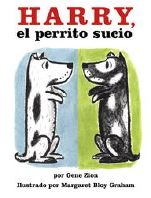
I would be the first one to agree that I would rather spend limited shopping dollars on Harry the Dirty Dog rather than on Clifford the Big Red one. And is it coincidence or just great good luck that Harry happens to be available in a bilingual edition with library binding to boot, as Harry, el perrito sucio?

Here are a few other substitutes I thought of this weekend:

Instead of the dreadful Princess School: Beauty Is a Beast, how about a real princess school, Princess Academy, the Newbery Honor book by Shannon Hale; or To Be a Princess: The Fascinating Lives of Real Princesses by Hugh Brewster and Laurie Coulter (sadly, apparently now out of print); or the pair of Robin McKinley's Beauty and the Beast retellings, Beauty: A Retelling of the Story of Beauty and the Beast and Rose Daughter; or a nice inexpensive shelf-full of the Dover reprints of Andrew Lang's "color" Fairy Books?

Instead of Disney's Christmas Storybook, might I suggest Jan Brett's Christmas Treasury? The oversize volume includes Brett's The Wild Christmas Reindeer, Trouble with Trolls, The Twelve Days of Christmas, The Mitten, The Hat, Christmas Trolls, and The Night Before Christmas.

I'm not sure of the particular "Rapunzel book" mentioned in the newspaper article, but you certainly can't go wrong with Paul O. Zelinsky's beautifully illustrated, well-told, Caldecott Medal winning version.

By the way, on a home education list this morning I found information about the Oklahoma Library Association's Sequoyah Book Awards program, established to encourage "the students of Oklahoma to read books of literary quality." Might be something for the folks in California to consider.

Another aside here, because this has been niggling at me for the past few days, from the newspaper article again: "Of the Potter, Artemis Fowl and 'princess' books, [a parent] said, 'The fifth-graders, that's all they're into. They can't afford $30 books. They will lose interest in reading and lose interest in academics.' "

You know, one can get good books quite cheaply (psst... new at Bookcloseouts, new and used at Amazon, Powells, and abebooks.com, and even at one's local secondhand book shop). And one can, and should, interest kids in quality writing from an early age, so that one doesn't have to fall back on the argument that if they can't read the likes of Princess School or Artemis Fowl, they'll lose interest in reading, which almost sounds like a threat to me. Reminds me very much of the "chicken nugget" theory of kids' food, which Jennifer Steinhauer wrote about the other month in the New York Times Sunday Magazine; she cited some chefs' rules at home for making sure their kids "not only eat better [but are] better eaters":
4. Eschew Baggies filled with Goldfish. (Car rides are exempt). "If kids are hungry, they're going to eat," [one chef] said. "If you fill them up on [Disney books] Bugles, they won't."

5. Buy them the most expensive chocolate you can afford. Who craves Ho Hos when they've had Scharffen Berger? I do. But I wasn't raised on the good stuff.
Moral of the story? Raise your kids on the good stuff and teach them the value of quality, whether it's food or books and whether you're a family or a school. It doesn't cost any more and is better for you in the long run.

I have to go lie down now. And read my kids a good book. And eat some dark chocolate (which I may or may not share with them).

No more next year country for some

Heard this discouraging story, "Frustrated Alberta farmers pack it in," on the radio this morning. It's getting lonely out here on the prairies.

Not to mention worrying, with a not-too-distant future where the transnational food factories of Archer Daniels Midland and Cargill control what we all eat.

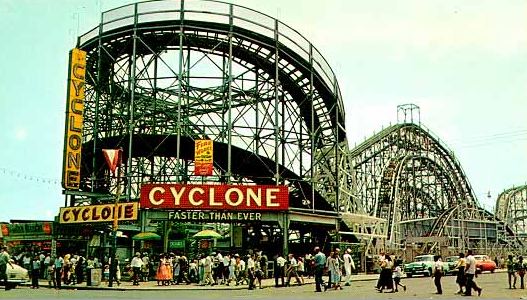
The second Carnival of Children's Literature, Number 2: A Coney Island Adventure is...

up and running at Chicken Spaghetti with an amazing selection of rides and articles. Definitely something for everyone -- come one, come all!

March 05, 2006

A good time was had by all

Last night was the kids' performance of Pinocchio, under the direction of two amazing directors/actors from the travelling Missoula Children's Theater company. In less than a week, 50 kids from ages five to 17, from two different schools and the homeschooling community, put on an amazing production of the classic story, complete with singing, dancing, and some dandy costumes. And gained more than just a bit of professional theater experience from two very dedicated teachers. Many thanks to Eric and Melanie for their terrific job, and to Missoula for making real theater possible even for those of us who live far from the bright lights and big cities.

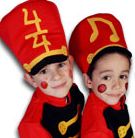
The boys were both wonderful as toy soldiers, and the costumes were beautiful -- tall red hats, red jackets with tails, and big red dots on their cheeks. Davy made the most of his role as the lead toy, carried around (lying stiff as a board) by Mrs. Geppetto, and then hiding in the Toy Box, ready to pop out when the dancing puppets opened the lid (and without falling asleep, which was my concern). Laura got quite a kick out of being a Pleasure Island Child, first skipping around and singing about the joys of school (tee hee), and then as a member of a junior donkey chain gang, after succumbing to Donkey Fever.

All three, not surprisingly, are planning their auditions for next year.


Not my kids (this picture is from the Missoula website) because my digital camera is still living in my sock drawer, but an idea of what the costumes looked like, because I was so impressed with the quality and effort involved.

Happy Birthday to the "Father of American Illustration"


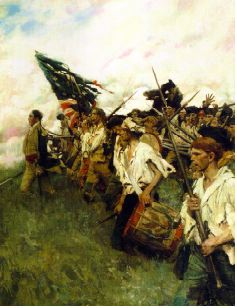
Nation Makers by Howard Pyle, 1853-1911

March 04, 2006

Building character, banning books

Camille at Book Moot and Gregory at Gotta Book both wrote yesterday about the school board book police in California who approved the removal of 23 books from a list of books to consider purchasing for the school library. Among the books are some of the usual suspects like Harry Potter and the Half-Blood Prince and a couple of Artemis Fowl titles, but also some more unusual and you'd think innocuous ones like Clifford the Big Red Dog, Disney's Christmas Storybook, and Princess School: Beauty Is a Beast. Not for the most part classic or even good literature, and in some cases not even literature at all. HOWEVER, and these are a couple of big howevers, 1) as Camille points out, "Generally, books sit very quietly on the shelves," and 2) take a look at the criteria on which the decisions were based: "Trustees said one rejected book contained an unsavory hero who made a bad role model for children; another was about a warlock, which they said was inappropriate; and" -- hang on to your hats, this is my favorite part -- "others were books with which they were unfamiliar and didn't know whether they promoted good character or conflicted with textbooks."

Good character, eh? I suppose that does away with quite a few books on our shelves, including many of my favorite characters: the anti-social loner Harriet (at the least off her meds, and very possible pathological); the headstrong, strongwilled, and frequently disobedient duo of Laura Ingalls and Caddie Woodlawn; several brother-sister teams, including Fern who lacks self-control and opposes her father and her gun-toting brother Avery (both moments vividly illustrated, too, for Pete's sake), and fugitives Claudia and Jamie (who's a gambler to boot); not to mention the poster children for bad behavior, Peter Pan and Pinocchio, and the poster children for banned books, Tom and Huck. And what about an entire family of disrespectful, nosy, rude, ungrateful children, so otherwise beloved by those otherwise not so wild about Harry, who go poking around where they're not supposed to, considering the fact that they're guests in someone else's home?

I take that back. My favorite part is the quote from one trustee, a retired teacher no less, who said the latest Harry Potter book was rejected because it is, purely and simply, fantasy: "We want books to be things that children would be able to relate to in real life." Which definitely finishes off any books on school library shelves with talking pigs and spiders, flying children, giant peaches, fantastic foxes, phantom tollbooths, flying carpets, magic seeds, mice who drive, swans who play musical instruments, and boatloads of dragons and fairies. You'd better throw in talking lions and fauns, too, not to mention man-eating whales and burning bushes while you're at it. What a dismal, limited view (or should that be vista?) of childhood and real life is to be had at, er, Vista San Gabriel.

And while I fall in the Charlotte Mason camp about twaddle, which in my book covers things like Disney's Christmas Storybook, I tend to think that such concerns are far, far overshadowed by two enormous, wrong lessons the Antelope Valley students are learning from the board's decisions. First, that it's correct to judge a book by its cover, disapproving of a title with which one isn't even familiar; is it too much to expect these trustees, even the ones who aren't former teachers, to read the books bothering them? It's not as if these are doorstop tomes such as War and Peace that might be expected to tax bears of little brain and their ilk. We're talking Princess School, people, which isn't much longer or more taxing than the average shopping list. And second, that a library shouldn't include any books that conflict with textbooks, which with a few exceptions tend to be committee-written, dumbed down, boring, uneducational, politically correct drivel. Is this really what they want the school's children to be learning? Any Antelope Valley parents who take this lying down are doing their kids a tremendous disservice.

"Report a Challenge", anyone?

March 03, 2006

Book pairings for a "one-two" punch

(Sorry about that first, unfinished version of this post that was accidentally published early. I had a Toy Soldier with a bad cough on my lap while at the computer, and I think his sword hit publish too soon, instead of "save as draft"...)

Children's author and reading dad Chris Barton over at Bartography talked about "the power of the one-two punch" the other day; the idea came to him after reading Book Moot's review of the Empire State Building picture book Sky Boys. In her review, Camille wrote that she thought "this book is more easily shared as a read-aloud than Elizabeth Mann's excellent Empire State Building."

Which prompted Bartography to suggest "other nonfiction pairings that can make the most of any sparks set off by a reader's initial exposure to a topic" -- including Kay Winters' Abe Lincoln: The Boy Who Loved Books and Russell Freedman's Lincoln: A Photobiography -- and wonder, "What one-two nonfiction punches can you recommend?"

This sort of pairing happens a lot around here, especially since we've got a five-year-old who's not reading yet, a six-and-a-half-year-old emerging reader, and an eight-year-old who is on to chapter books, but who all like to stay on the same page, so to speak, whether the topic is just-for-fun or one of our current history, literature, or science subjects.

A few quick pairings -- among the kids' very favorites -- from the past few years would include:

Columbus, a lovely picture book biography written and illustrated by Ingri and Edgar Parin d'Aulaire; and
The World of Columbus and Sons written, and briefly illustrated with beautiful pen and ink sketches, by Genevieve Foster, moves beyond the life and times of the explorer himself to what was happening to the rest of the world at this exciting period in history.

William Tell, retold and illustrated by Margaret Early; I'm a big fan of her picture books, especially because she, like Diane Stanley, uses the style and technique of the historical time in which her story is set. So her illustrations for William Tell recall delicate manuscript illuminations, complete with gold leaf details; and
The Apple and the Arrow, written and illustrated by Mary and Conrad Buff. The 1952 Newbery Honor winner offers a much fuller retelling, and through the eyes of William's son Walter.

And, because I can never leave well enough alone, for a one-two-three-four-five punch:

Kate Waters's wonderful Pilgrim Times series, each photographed by Russ Kendall at Plimoth Plantation -- Tapenum's Day: A Wampanoag Indian Boy in Pilgrim Times; Samuel Eaton's Day: A Day in the Life of a Pilgrim Boy; Sarah Morton's Day: A Day in the Life of a Pilgrim Girl; and Giving Thanks: The 1621 Harvest Feast; along with
The Landing of the Pilgrims, written and illustrated by James Daugherty (a Landmark book).

Finally, here's a three-punch the kids never tire of each winter; all three books are out of print, but you can probably find them at the library or, as we did, at a library discard sale. This past fall, the kids dug them out to make double sure that our mama bear and her cub would be sleeping:

How Animals Sleep (also published as A Time for Sleep) by the magnificent Millicent Selsam, with illustrations by Ezra Jack Keats; a terrific little Scholastic paperback from the fifties. Ours is a 1962 reprint;
Animals in Winter by Henrietta Bancroft and Richard G. Van Gelder, illustrated by Gaetano di Palma, who used to be a scientific illustrator at the American Museum of Natural History in New York. Another Scholastic gem from the 1960's, now reborn as a volume in the "Let's Read and Find Out Science" series; and
Where They Go in Winter by Margaret Waring Buck. Her books are absolute masterpieces of natural history for young scientists and budding natural historians. Includes a complete index of all the animals, along with their Latin names, and list of additional books to read.

So any pairs you'd care to share?

March 01, 2006

Adding even more poetry to your life, just in time for National Poetry Month

Susan at Chicken Spaghetti posted this morning about the free poster to celebrate National Poetry Month in April. Many thanks to Susan for the link, and to the Academy of American Poets for the poster, which is available to teachers, librarians, booksellers, students, and community center staff. Naturally the teacher and student bit caught my eye -- I'm assuming that those two categories include home educating families, and just to be sure sent the Academy a query by email for the official okey dokey (will post the answer here when it comes)*. Unfortunately, the poster can't be shipped internationally, so those of us living in Canada and elsewhere out of the U.S. can have it shipped to poetry-loving family members or friends who happen to be residing in the 50 states...

You can also take a look at previous years' posters, some of which can still be ordered for $5 each.

Susan also mentions the Academy's list of 30 ways to celebrate poetry month in April, part of the National Poetry Almanac -- 365 days' worth of poetry highlights, activities, ideas, and history for individual exploration and classroom use. Is it any wonder I'm feeling faint all of a sudden? And you might also be interested in the Academy's Poetry-Read-a-Thon 2006, for children in grades 5-8. Intrepid home school types can find out if you can register your kids, and if you can adapt it for younger poetry-loving types. If you need an incentive, know that "classrooms will be entered into a raffle to receive one of five $250 donations from the Academy of American Poets toward their school library’s acquisition of poetry books." Even if you decide not to participate, there is a downloadable Teacher's Guide.

The Academy website is full of goodies. You can sign up (free registration required) for a Poem-A-Day, selected from new books published this spring, to arrive in your email in box. The "Poetry Near You" link lists, among other things, a Calendar of Events, a National Poetry Map, and the Poetry Book Club. The "For Educators" link made me giddy: Curriculum and Lesson Plans; Essays on Teaching by Jim Trelease, Kenneth Koch, Bill Zavatsky, and others; a list of Great Poems to Teach, with 341 titles (so you should be able to find something); Tips for Teaching Poetry; and the Teaching Resource Center, which in itself is a huge, amazing list of links. Go!

*Update: Had an answer to my query, and homeschoolers get the thumbs up from the Academy for the poster. Order away!

February 27, 2006

Pinocchio update

I am now the mother of two toys (possibly a toy soldier and a ball, or two balls, or two soldiers, but definitely no wind-up ballerinas) and a Pleasure Island child. We don't have to make rehearsal tomorrow afternoon, but from Wednesday to Friday, the kids have some long rehearsals. The boy toys from 3:45 to 5:45 p.m. every day, and Laura those two hours plus another two from 6:15 to 8:15 p.m. On Saturday, the day of performance, the kids start rehearsals at 2:45 in the afternoon and go until the first and only performance at 7 p.m.

Once again I'm grateful we homeschool. I have to talk to the teacher about letting the kids sleep in and skip some of that homework in the evenings, tee hee.

Nifty resource, and cheaper than a trip to DC

I read this weekend that the U.S. National Archives and Google have teamed up to digitize and make National Archives holdings available free to all online. This means anyone with a computer can now have access to historic movies, documentaries, and other films in the Archives.

You can check Archives' holdings at the official National Archives website as well as at a Google website. At the moment, the pilot program covers 101 films, including some U.S. government World War II newsreels; several NASA documentaries on the history of the spaceflight program; and some documentaries on the history and establishment of a nationwide system of national and state parks, Boulder Dam, the Civilian Conservation Corps, and the Tennessee Valley Authority.

The kids and I took a look through the links and found the following gems (the download takes too long for us dial-up types, but one can hope):
Even better news: the National Archives and Google are considering the possibility of expanding the current online collection -- which at the moment includes the Declaration of Independence, the 1918 influenza epidemic, 20th century photographs and photographers, the meeting of Nixon and Elvis, and much, much more -- and making the Archives' extensive textual holdings available on the internet. Yahoo! Er, I mean Google!